Positioning is Infrastructure
Most founders treat positioning as a marketing deliverable. Something you commission after the product works, somewhere between the pitch deck refresh and the website rebuild. A paragraph you approve, paste into the About page, and stop thinking about. That is a category error, and it is expensive.
Positioning is not the paint. It is the load-bearing wall.
What positioning actually is
Positioning is the decision about what you are, who you are for, what you are against, and why that matters now.
Everything people call brand is downstream of it. Your tagline expresses it. Your messaging argues it. Your identity makes it legible in three seconds to someone who will not read your paragraph. None of those can be good if the decision underneath them was never made, which is why so much brand work comes out vague. Vagueness is what language does when there is nothing beneath it.
The most expensive version of this, and the deep tech default, is a position that is really just a description. A description tells people what you built. A position tells them what changed in the world, and why what you built is the inevitable response. Founders reach for description because it feels precise and safe. It is neither. It hands the audience the interpretive work, and audiences do not do interpretive work. They leave.
One test. If your positioning could be swapped onto a competitor’s site without anyone noticing, you do not have a position. You have a category summary.
What it takes to arrive at one
Positioning is not a writing exercise. It is a sequence of decisions, most of them subtractive, and no amount of phrasing rescues a company that has not made them.
Find the real competitive frame. Not your competitor slide. The thing your buyer actually weighs you against, which is usually the status quo, an internal team, a spreadsheet, or nothing at all. Most companies position against the names in their deck and lose to an option that was never in it.
Identify the shift. Every durable position rests on a claim about what changed: the technology, the regulation, the supply chain, the threat, the cost curve. Without a shift you are asking to be preferred. With one you are showing people they have already been overtaken.
Choose the opponent. Not necessarily a company. An assumption, a default, a behavior. This is the decision that forecloses options, which is exactly why it is the one that determines who amplifies you.
Enter a category or define one. Entering means accepting the buyer’s criteria and winning on them. Defining means arguing the criteria are wrong. Defining costs more and takes longer, and it is the only position a competitor cannot copy without becoming you.
Pressure-test it against the company. A position is real only if it survives the roadmap, the hiring plan, and the pricing page. When the position and the org chart disagree, the org chart wins.
That is where positioning stops being language and becomes infrastructure. A real position constrains behavior: which customers to turn down, which features to skip, which impressive hire is wrong. If yours has never cost you revenue, it is decoration.
The pattern: category definers build the category first
What follows are companies that took the harder path. In each case the position came before the product was finished, the category existed, or the buyer had asked for it. And in each case you can trace the position into something physical: a supply chain, a rendering engine, a cap table, a factory floor.
Infrastructure is invisible when it works. Nobody admires the foundation. They admire the building.
Anduril: defined the defense product company
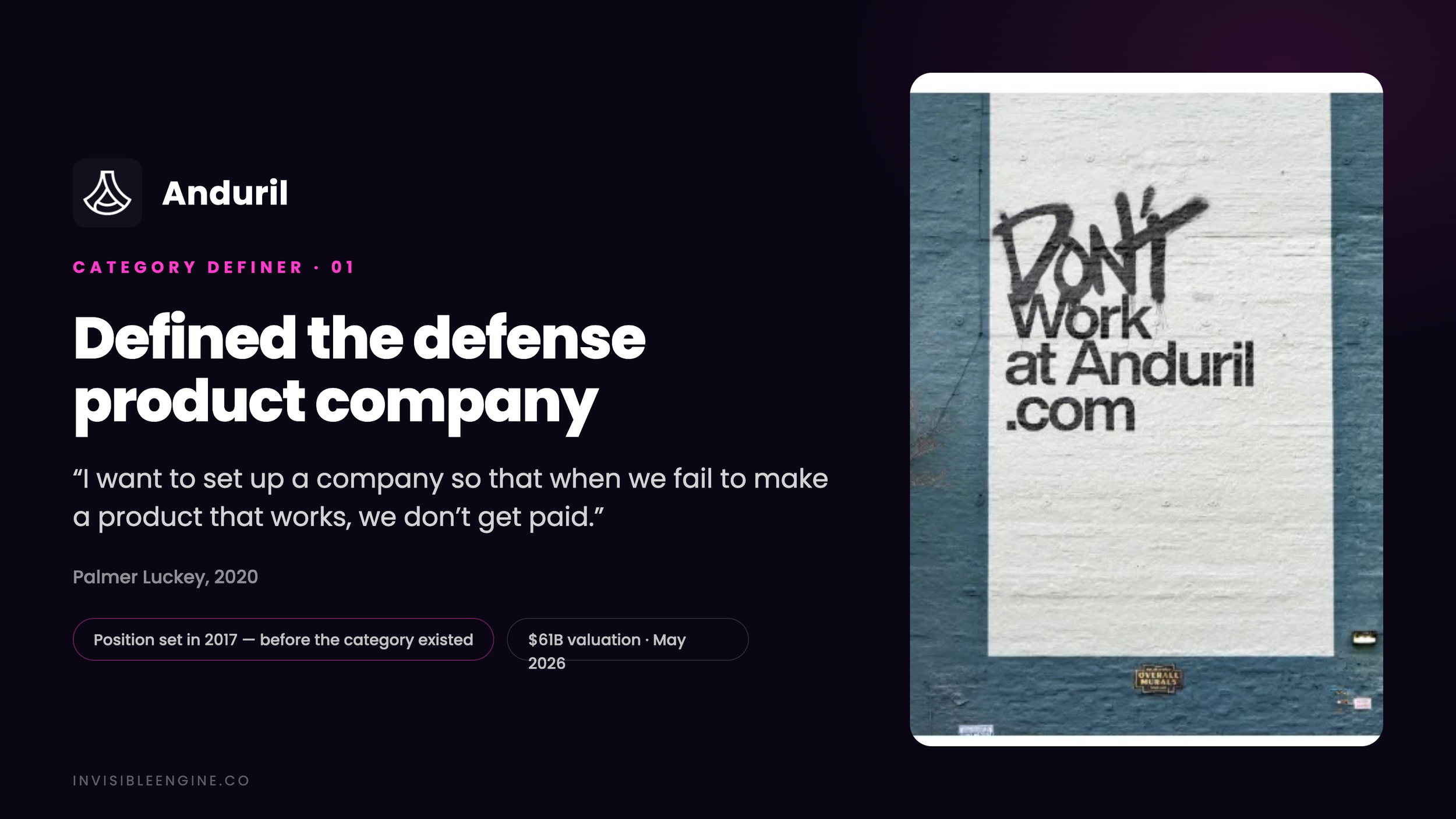
Anduril did not enter defense contracting. It argued the contracting model itself was the problem. Its 2022 mission document takes apart cost-plus contracts, where vendors are paid costs plus a fee of typically six to eight percent, meaning "working quickly and efficiently often conflicts with contractors’ profit motives." The alternative: "most companies do not get paid until they build a finished product. That can and should be the case in the defense industry, too."
Palmer Luckey, in 2020: "I want to set up a company so that when we fail to make a product that works, we don’t get paid."
That is not a message. It is a business model, and it dictated the rest. Self-funded R&D required venture capital at a scale defense had never attracted. Owning the IP is what made a common software core like Lattice possible. CEO Brian Schimpf: "We’re investing off balance sheet. We want to get these things out. We don’t make any money until it actually works." The position was set in 2017, when the category did not exist. The company announced a $5B raise in May 2026 at a $61B valuation.
Figma: defined multiplayer design
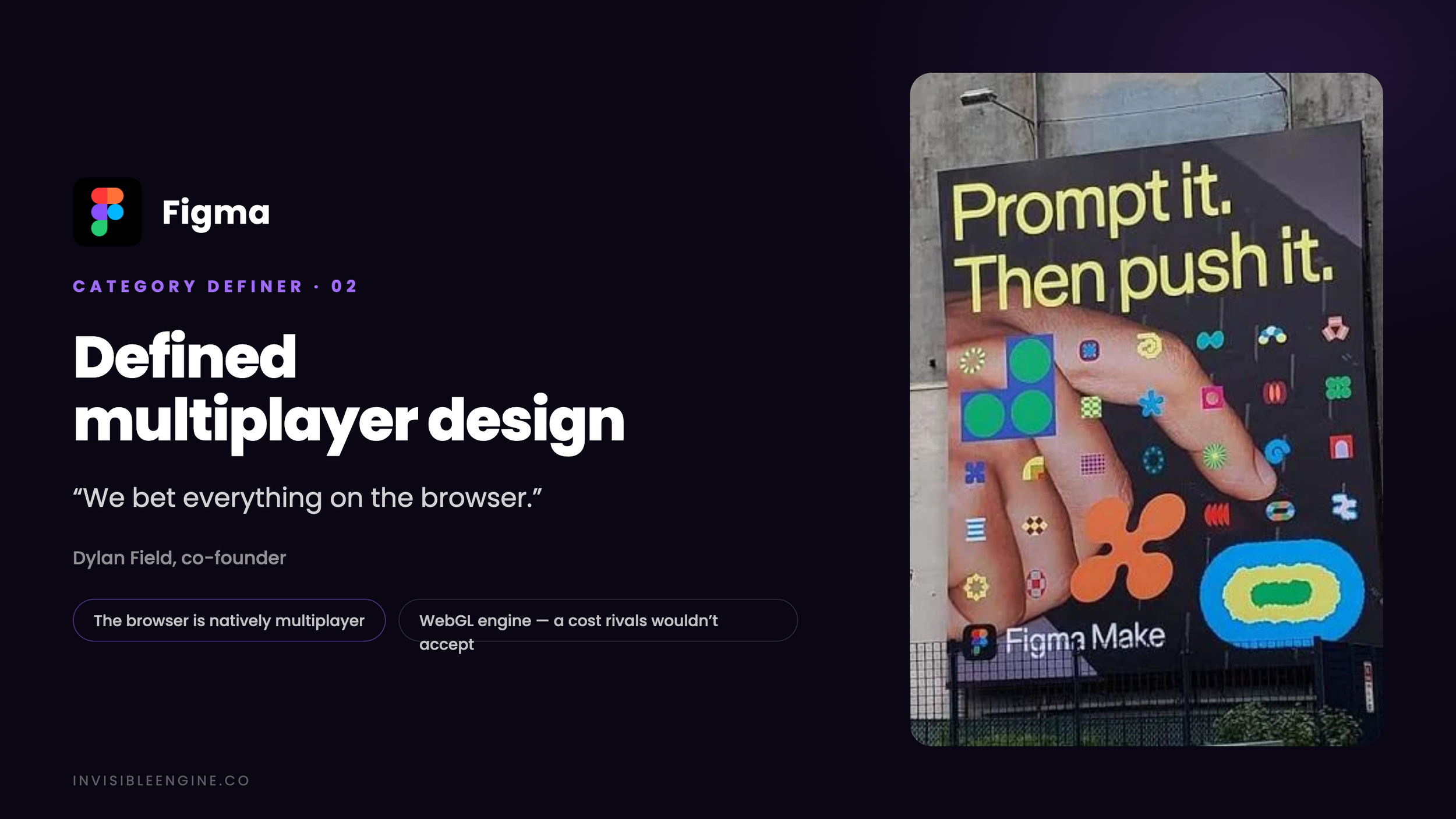
Dylan Field did not position Figma as a better design tool. He positioned against the single-player assumption underneath every design tool. Designers, he wrote, were "in the dark ages when it comes to collaborative workflows" relative to engineering.
So: "we bet everything on the browser." And the reasoning, which is the sharpest statement of this whole idea I have found: "The browser is natively multiplayer. It forces a mindset shift on access. It strips away the need for expensive hardware."
That decision required building a rendering engine in WebGL, a cost most competitors would not accept. It ruled out the native-app distribution model Adobe had built a business on. It changed pricing, because access stopped being gated by hardware. The category definition came first; the engineering bill came after.
Liquid Death: defined water as a fun brand
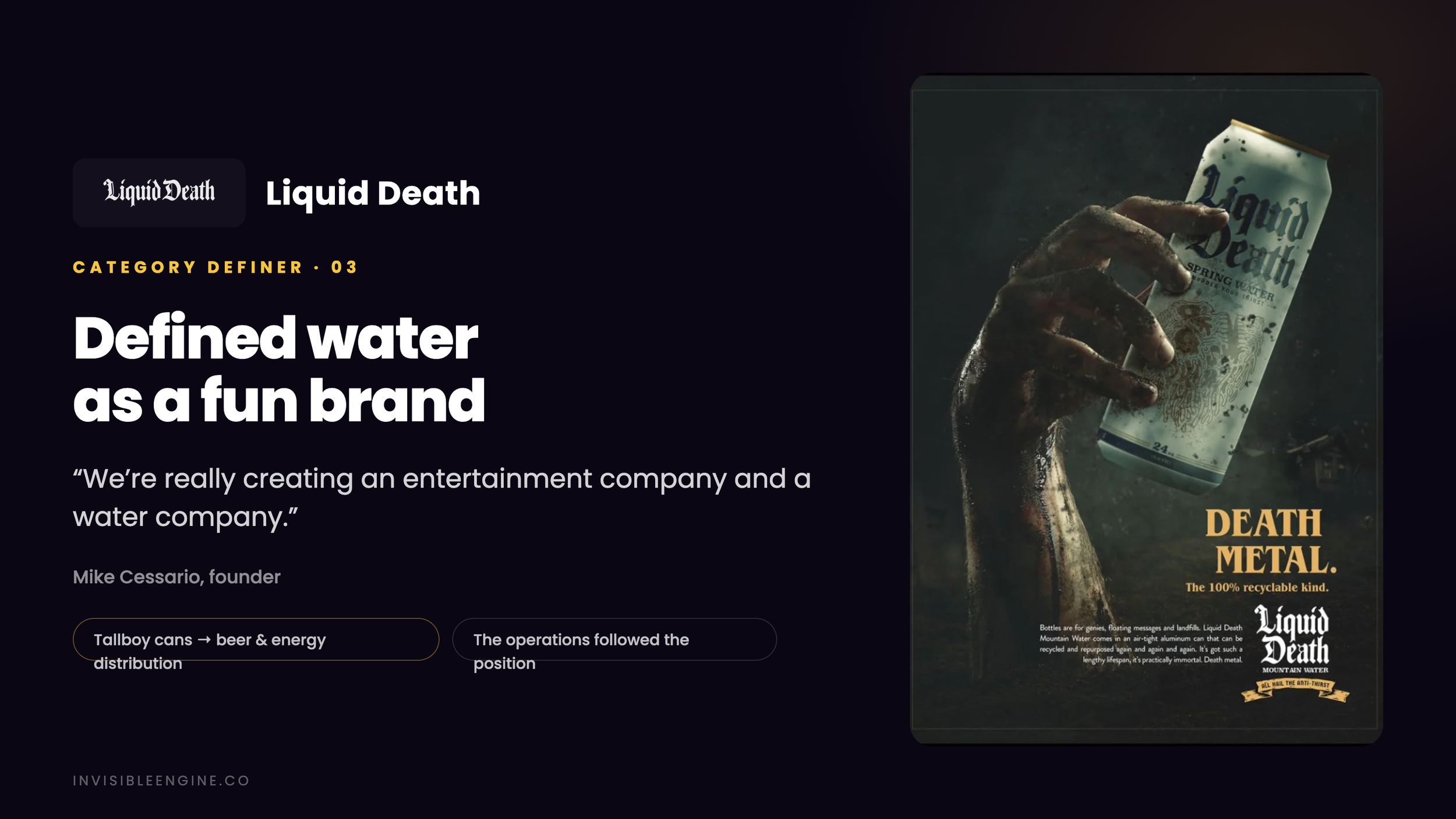
Mike Cessario’s framing to CNBC: "We’re really creating an entertainment company and a water company." Note the and. Both halves are load-bearing.
The insight was that water was competing in the wrong aisle. In his words, the goal was to package it "into infinitely recyclable tallboy cans that can actually compete with the fun marketing of unhealthy brands across energy drinks, beer, and junk food."
A tallboy can is not a design choice. It is a manufacturing decision requiring canning lines rather than PET bottling, and a distribution decision that puts you in beer and energy drink networks rather than water. Capital-intensive, and hard to reverse. The brand did not follow the operations. The operations followed the position.
Oatly: defined itself against dairy
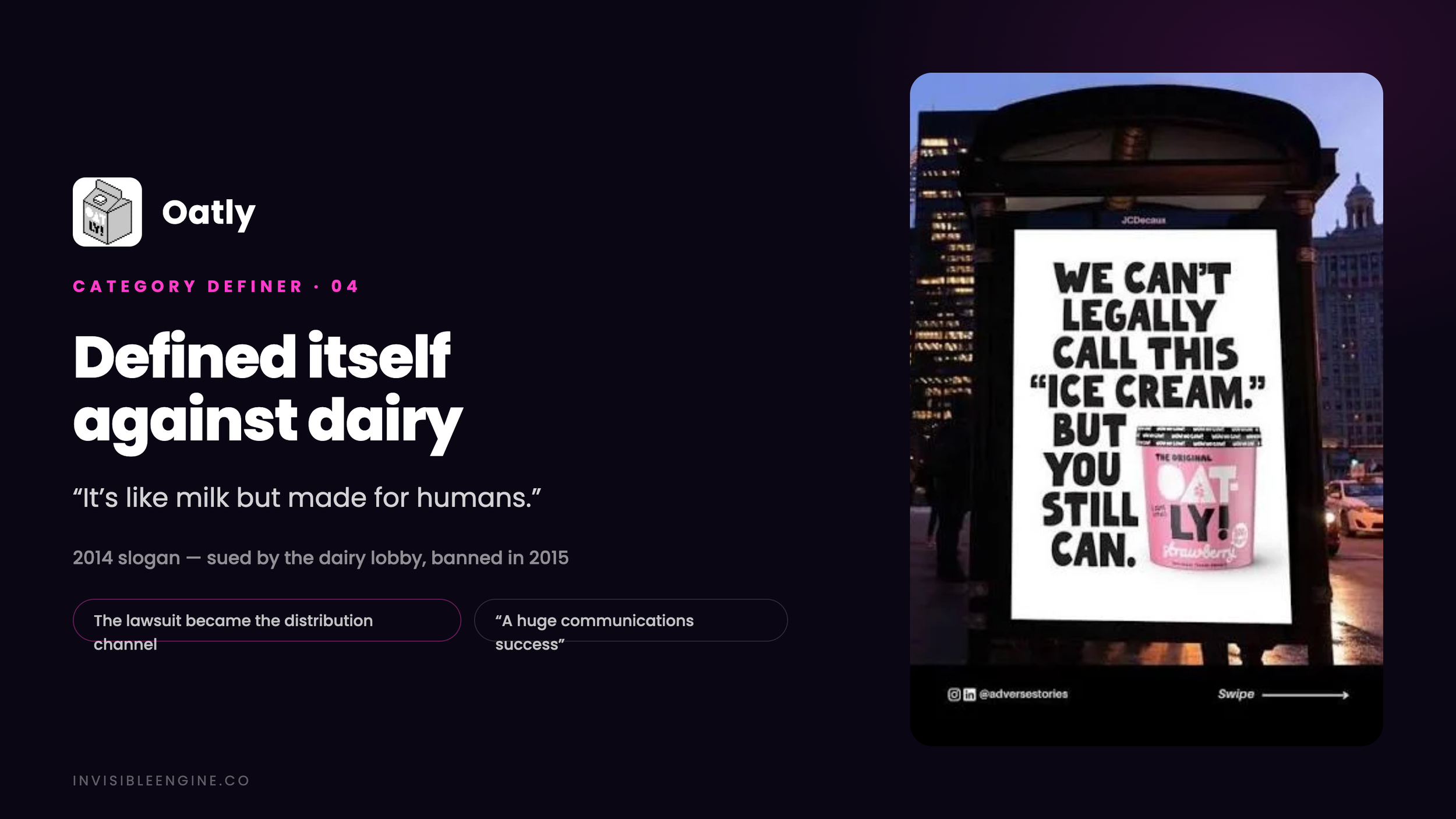
Oatly’s 2014 Swedish line was "It’s like milk but made for humans." The dairy lobby, LRF Mjölk, sued. In 2015 a court ruled against Oatly and banned the slogan.
By normal accounting, a loss. Oatly’s creative director Martin Ringqvist called it "a huge communications success" that "generated a huge number of positive headlines for the company. Sales soared."
That outcome is only available to a company that chose its opponent deliberately. Position oat milk as a health product and the dairy industry is irrelevant to you. Position it against dairy and the dairy industry’s trade body becomes your distribution channel. Credit where it is due: the work, including the "Wow No Cow" film with then-CEO Toni Petersson singing in an oat field, came from Swedish agency Forsman & Bodenfors in 2014, years before the Super Bowl spot people remember.
Worth noting honestly: Oatly’s "Post Milk Generation" trademark fight in the UK ended badly, won at the High Court in December 2023 and lost on appeal in December 2024. Provocative positions are real bets with real costs. That is the point.
Patagonia: defined the purpose-led company
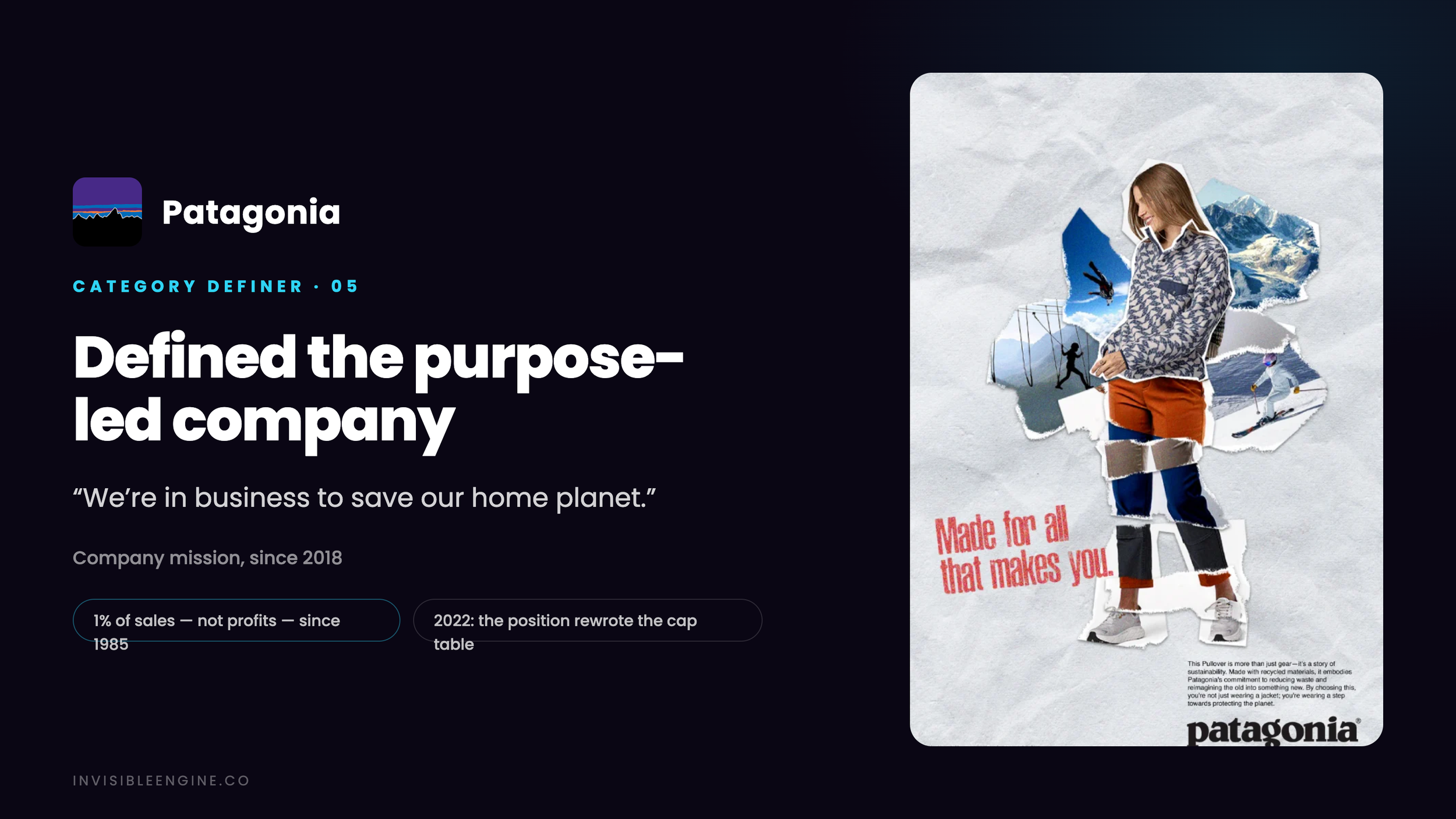
Patagonia’s position is not a marketing claim about outdoor apparel. It is a claim about what a company is for, stated since 2018 as "We’re in business to save our home planet." Follow it into the operations and it stops being rhetoric.
Since 1985 the company has pledged one percent of sales, not profits, to environmental work. That distinction is the entire argument in miniature: a percentage of sales is a fixed charge against revenue, payable in a loss year. Positioning determined the cost structure.
In 1994 Yvon Chouinard mandated the sportswear line convert to one hundred percent organic cotton within eighteen months, or the company would stop selling sportswear. By the 1996 line it was done, at a cost the company documents plainly: the line shrank from 166 products to 66 styles, procurement had to be rebuilt from the farmers up because organic supply chains did not exist, margins were cut, and it took two years for sales to recover.
Then, in September 2022, the ownership structure itself: voting stock to a purpose trust, non-voting stock to a nonprofit collective. Chouinard’s line was "Instead of ‘going public,’ you could say we’re ‘going purpose.’" Critics fairly note he gave away the economics rather than the control, and the tax treatment drew scrutiny. Both things are true. The relevant point stands: the position eventually rewrote the cap table, which is as close to literal infrastructure as brand strategy gets.
What the absence looks like
You already know, because you have seen it.
Two co-founders describing the business differently on two different podcasts. The sales team inventing its own pitch because the official one does not survive contact with a buyer. The website redesigned every eleven months without ever getting better, because the problem was never visual. The investor update that reads like a different company than the careers page. The hire who joins for one version of the mission and leaves when they find another.
None of these are marketing problems, which is why marketing spend does not fix them. They are foundation problems surfacing as cracks. You can patch cracks indefinitely. The bill comes due at the Series A, when someone finally asks a question the company has never actually answered.
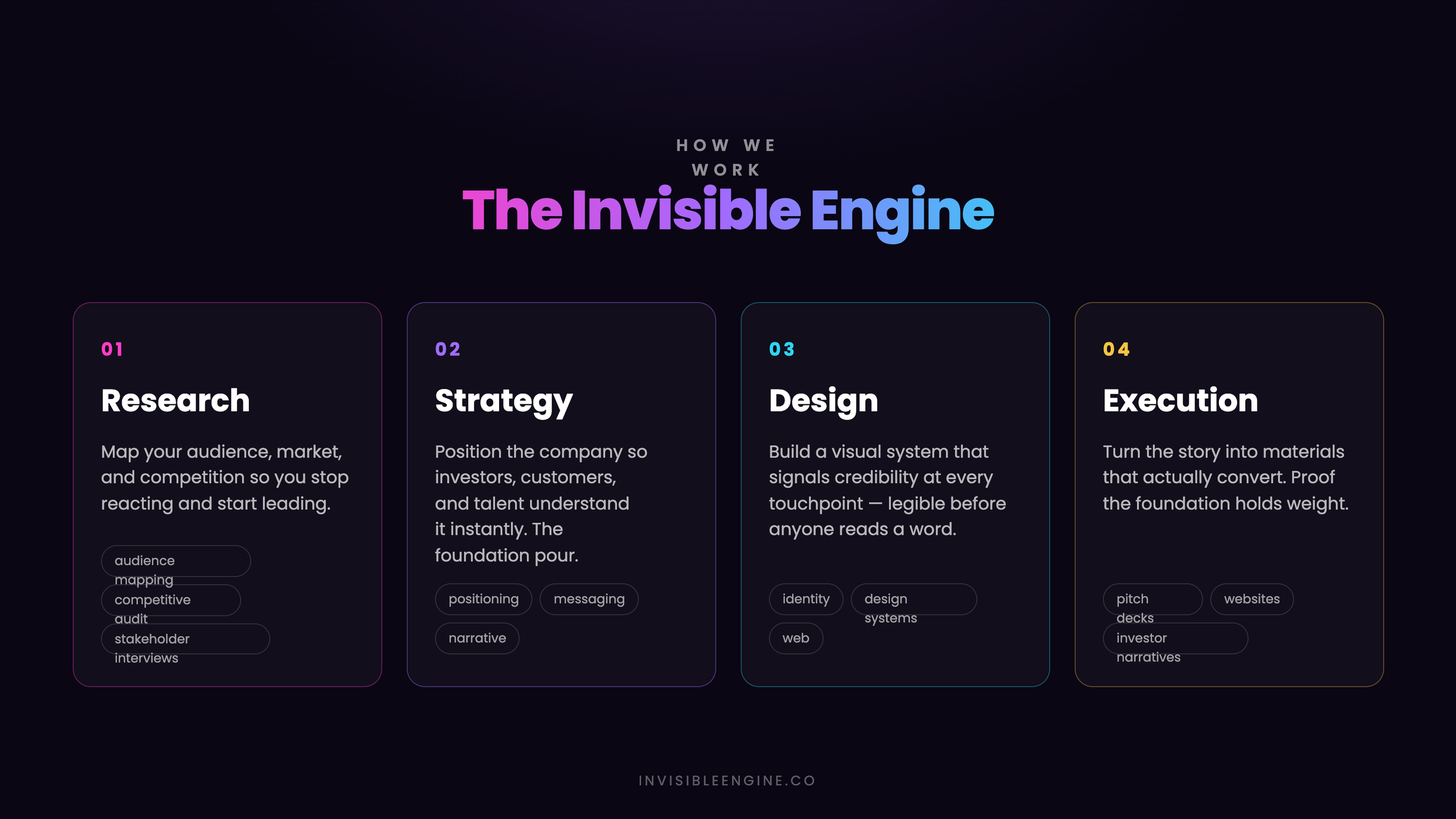
How we work
At Invisible Engine, we exist to close the gap between innovation and understanding. In deep tech, defense, frontier science, and advanced manufacturing, that gap is usually the widest thing about the company: the technology is real and the explanation has not caught up.
We run four phases, in this order, for a reason.
Research. We map your audience, your market, and your competition so you stop reacting and start leading. Audience mapping, competitive audit, stakeholder interviews. This phase exists because a position built on assumption is just a preference with better formatting.
Strategy. We position your company so investors, customers, and talent understand it instantly. Positioning, messaging, narrative. This is the foundation pour, and it is where the subtractive decisions get made.
Design. We build a visual system that signals credibility at every touchpoint. Identity, design systems, web. A system that makes the position legible before anyone reads a word.
Execution. We turn your story into materials that actually convert. Pitch decks, websites, investor narratives. The proof the foundation holds weight.
We work with pre-seed through Series A companies, because that is the window where positioning is still cheap to get right and catastrophic to get wrong. After Series B you are not positioning. You are renovating around structural decisions you already made.
If you are building something real and the explanation has not caught up yet, that is a solvable problem, and it is the one we are built for.
Here for the guts, not the glory.