Kill your first three slides
The order every good pitch deck follows, and why your company does not appear until slide four
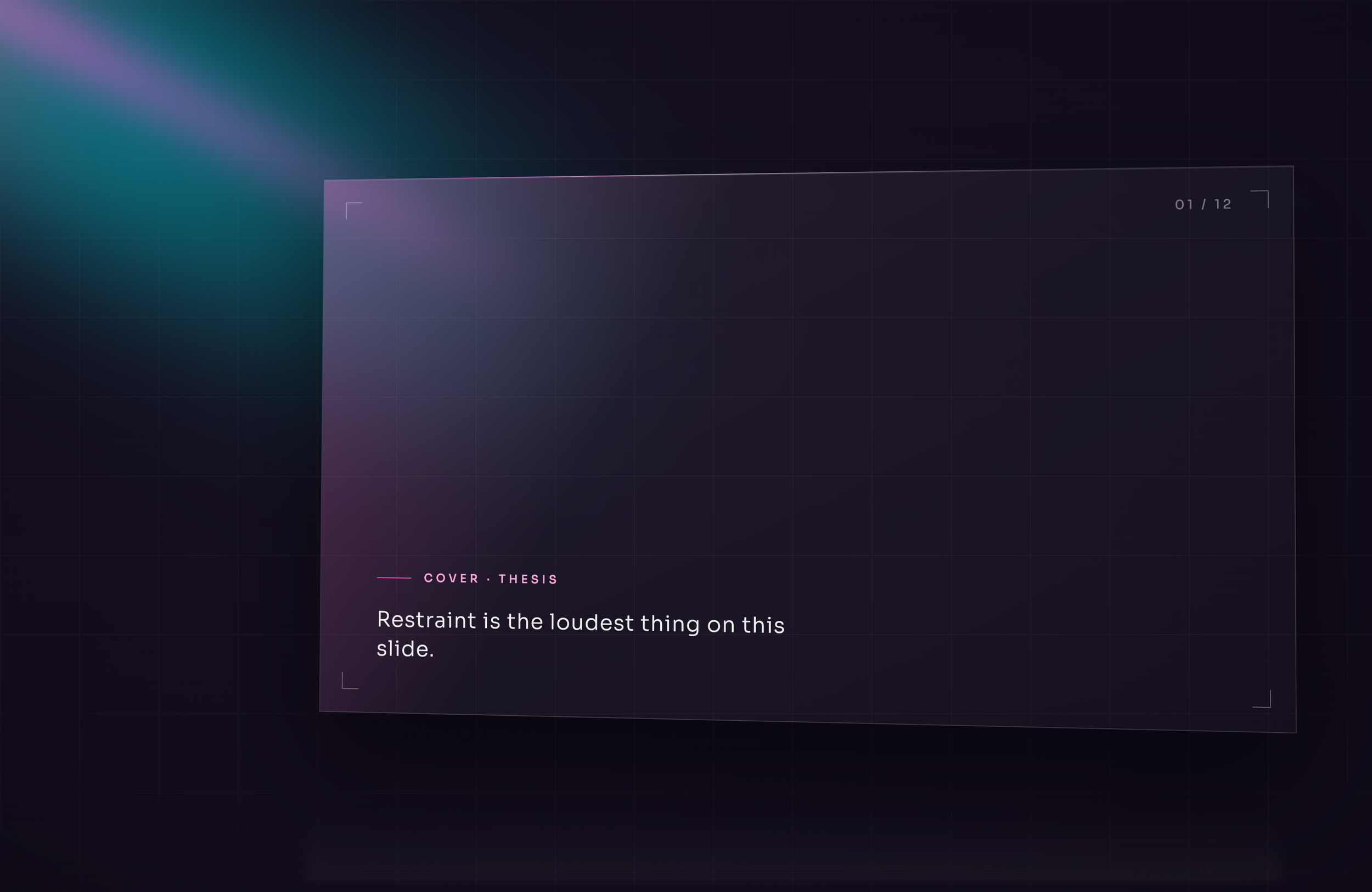
Open your deck. Look at slide one. Does it say what your company does?
Then you just spent the most expensive ninety seconds of your raise explaining yourself to somebody who had not yet agreed to care.
Nobody is going to tell you this. Investors are relentlessly polite about bad decks. They will sit through all thirty slides, nod at the right moments, thank you warmly, take a second meeting out of guilt, and never think about you again. You will go home and tell your cofounder it went well. It did not go well. It went politely, which is worse, because polite gives you nothing to fix.
So here is the fix. We build decks for frontier technology companies, and the ones that work are never the ones with the best design or the deepest technology. They are the ones in the right order. The order barely changes between companies, sectors or stages, which means it is not taste. It is a spine.
Your cover slide is not a name tag
The best covers we have ever built do not explain the company at all. They pick a fight. Say it cannot be done. See what cannot be seen. Six words. No product, no category, no three-letter acronym, no tagline about empowering anything.
Founders hate this. It feels like throwing away the best real estate in the deck. It is the opposite. A cover that describes your company is a name tag, and you are not at a conference. You are asking for ten million dollars. A cover that takes a position makes a promise the next twelve slides have to keep, and it puts the reader in the only useful posture there is: waiting to find out whether you can back it up.
One more rule. Whatever goes on the cover, the last slide says it again. Every deck we are proud of ends where it started. The deck is a loop, not a list, and the return is the difference between a deck that finishes and a deck that just runs out.
Nobody cares about you yet
This is the discipline almost nobody has, and it is worth more than everything else in this piece combined.
Your first three slides are about the world. Not your company. Not your team. Not your beautiful, hard-won, genuinely impressive technology. The world.
One: something is broken
Name it. Flatly. As an obstacle, not as a market. America lost the ability to make the metal parts that matter. The display is the thing holding the entire field back. One sentence, no adjectives, and it has to be verifiable by a stranger who has never heard of you.
Then put three or four hard numbers under it and nothing else. Domestic capacity lost. Years to build the old kind of facility. Months of lead time. And if you can find one, use a zero. A zero is the most violent number available to you, because every other figure can be argued down by somebody with a different model, and a zero just sits there.
Two: why now
The broken slide raises an obvious and slightly hostile question. If this is so broken, why has nobody fixed it, and what makes you the moment.
Answer with forces, not with your own progress. Three or four things that changed recently and had nothing to do with you. A technology walked out of the lab. A delay stopped being annoying and became fatal. Policy moved. Buyers stopped wanting to own things. Every one of them has to be true whether or not your company exists. That is the whole trick: you are not the reason the window opened, you are just the one standing in it.
Three: the lineage
This is the most underused slide in venture and it converts skeptics faster than anything else we build.
Put your category on a timeline that starts centuries before your seed round. Forging in 3000 BCE. Casting in the 1880s. CNC in the 1950s. Powder in the 1990s. Then you, at the end, as the next entry. Write each previous era honest limitation underneath it, fairly, without dunking.
Then look at what you just did. A startup announcing that it is a breakthrough sounds like a startup. The same claim, positioned as the next move in a five thousand year sequence, sounds like history. One of those gets argued with. The other one gets believed.
Three slides in there is no logo, no product and no team. You have dug a hole in front of the reader. Now you get to be the thing that fills it.
Slide four: fine, you can come in now
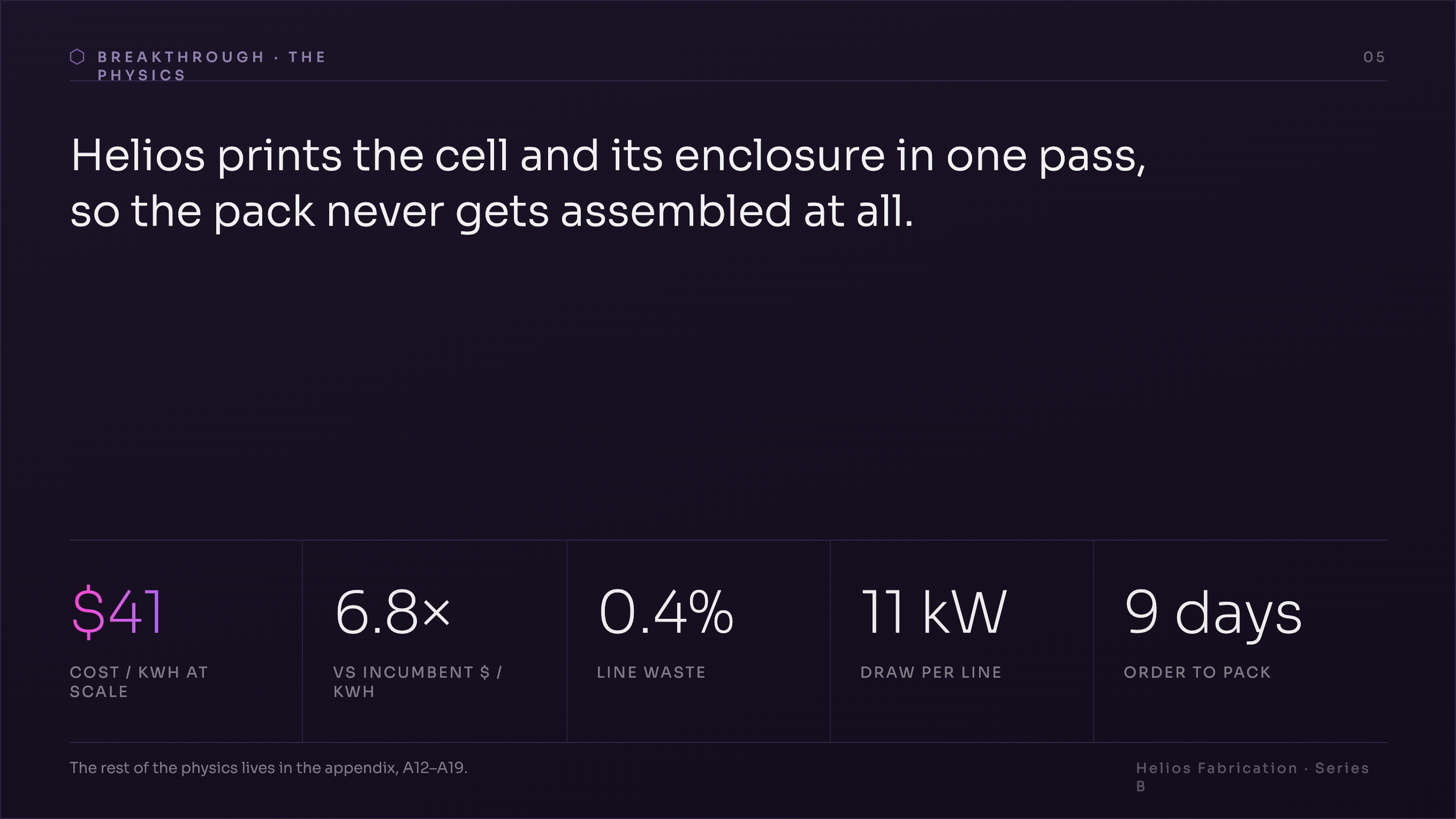
This is where founders panic, because three slides have gone by and their logo has not appeared. Sit in it. The logo was never the product. The hole is the product.
And notice what this costs you: nothing. Same material, same slides, different order. Reordering is free. It is the only free thing in fundraising and almost nobody does it.
One sentence of physics. One.
Slide four names the system. Not the company. The system. Give your core technology a proper name and then use that exact name every single time it appears anywhere, forever.
Then explain how it works in one sentence. The best one we have ever written runs nine words and contains no jargon: it does not make a screen, it makes the light that creates the image.
You want four sentences. Everybody wants four sentences. Four is where technical founders lose non-technical investors, and it happens in real time, and you can watch it happen if you ever look up from the slide.
The instant that sentence lands, switch to numbers. Cost at scale. Multiples against the incumbent on the axes that decide purchases. Waste. Power. Four or five figures, zero prose, then stop. Any additional physics goes in the appendix where the people who actually want it will find it.
Build the table. Lose a column on purpose.
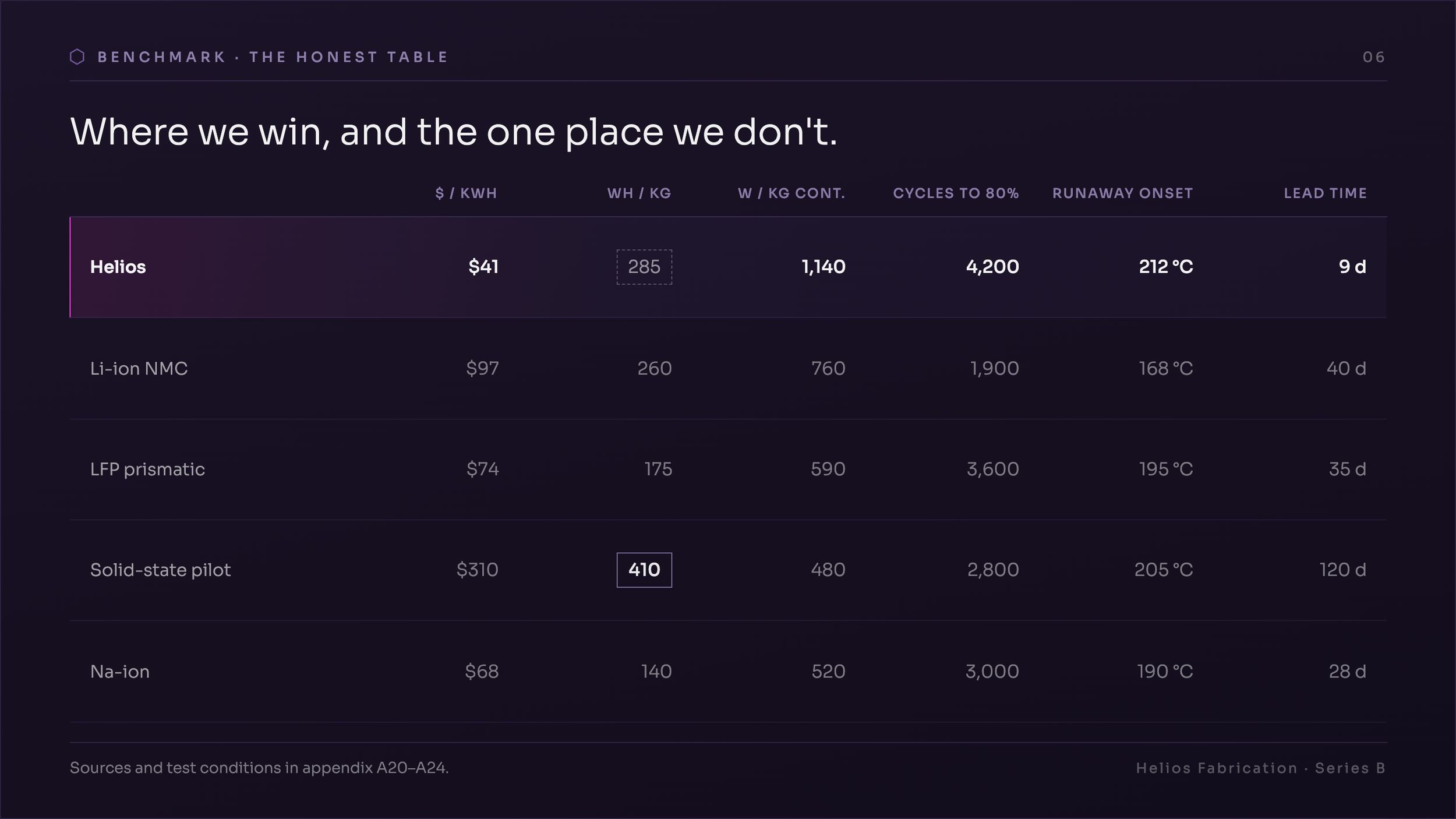
Never claim you are better in adjectives. Adjectives are free and everyone knows it. Build the table.
Rows are the named incumbent technologies. All of them. Including the ones that beat you somewhere. Columns are the things a buyer actually weighs: price, power, resolution, lifetime, resilience, whatever governs the decision. You go in row one.
Then let yourself lose a column. Deliberately. A table where you win everything is not a table, it is an ad, and investors read ads at the speed of a billboard. A table where you win six of seven and lose one honestly is engineering, and something useful happens the moment they see the loss: they stop auditing your motives and start checking your math. That is the entire game.
Right after the table, show breadth. Every vertical the technology touches, laid out plainly on one page. This is the slide where a component quietly becomes a platform, which is a different asset class, which is a different valuation.
Your TAM slide is in the wrong place
It is on slide three. It is on slide three in almost every deck ever assembled. Move it.
A giant market number shown to somebody who does not yet believe your technology works is a fun fact about an industry you happen to be near. The identical number shown ninety seconds later, after the benchmark, is a description of what you might get. Same slide. Same figure. You just put it in the wrong place, along with everyone else.
When you do build it, show your arithmetic. Total, addressable, obtainable, with the filter you applied at every step written out and the sources in the appendix. Investors do not disbelieve big numbers. They disbelieve numbers that appeared from nowhere.
Two moves for people who are actually going to do this
Run the spine twice
Platform companies have a specific problem: you sell a component, but the company is worth whatever the component makes possible. Trying to say both at once produces a deck that says neither.
So run the sequence at two altitudes. Broken, breakthrough, benchmark, market for the core technology. Then a hard section break. Then the same four beats again for the product it unlocks. The second pass is where the valuation lives. The first pass is the only reason anyone believes the second one. Do not merge them to save slides. The section break is load-bearing.
Build the appendix nobody builds
The main deck gets to compress, because you are standing there to absorb the follow-up question.
The appendix cannot compress, because whoever reaches it has nobody to ask. Sources and methodology behind every market figure. The process, step by step. The materials. The one piece of deep physics that proves the mechanism, with the actual curve or the actual yield data.
Almost nobody builds this. It is the cheapest credibility available to a technical company and it is sitting there unclaimed behind slide thirteen. A clean deck with a serious appendix tells a technical investor you understand the difference between an argument and a proof, and that you brought both.
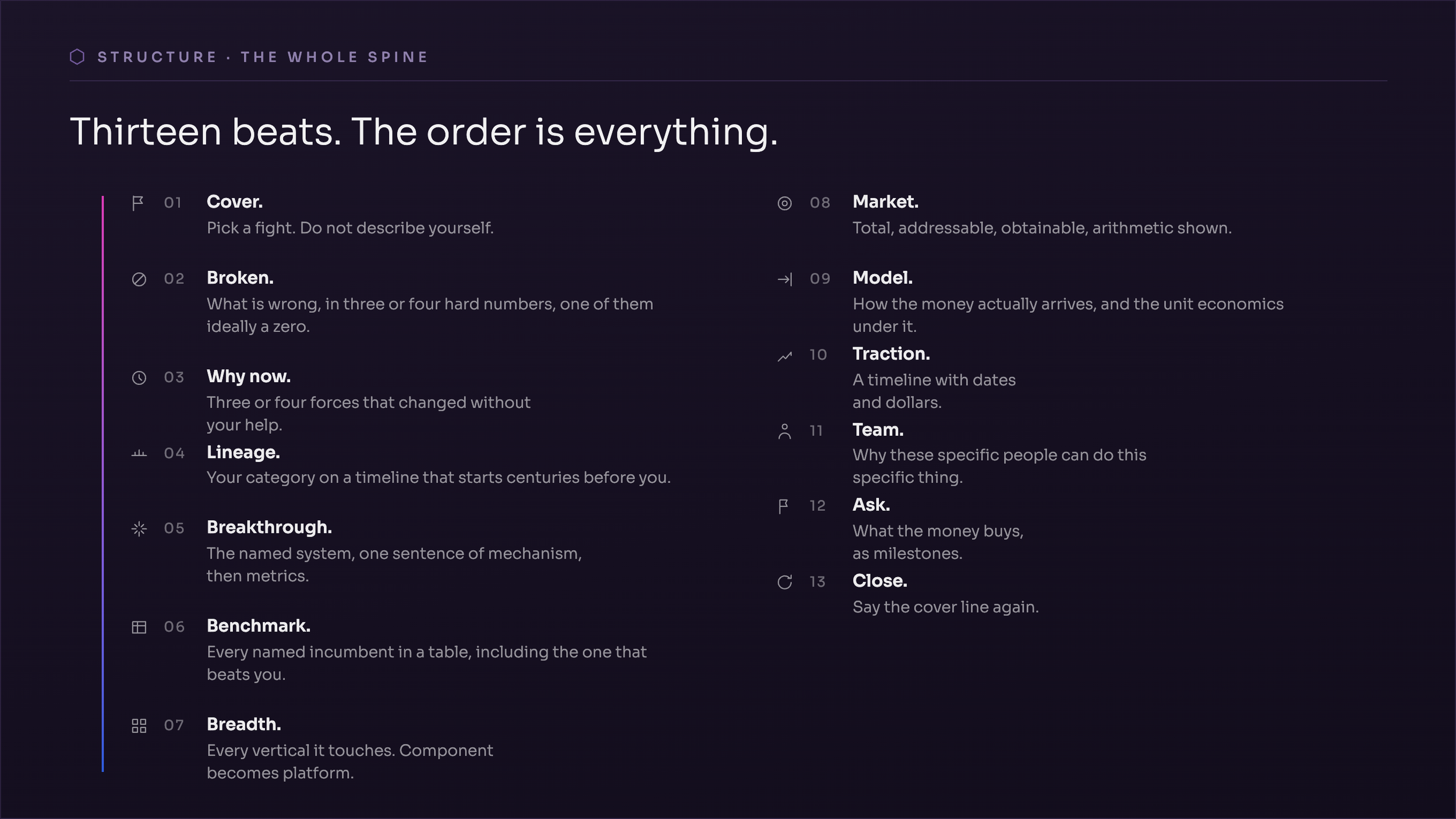
The whole spine
01 Cover. Pick a fight. Do not describe yourself.
02 Broken. What is wrong, in three or four hard numbers, one of them ideally a zero.
03 Why now. Three or four forces that changed without your help.
04 Lineage. Your category on a timeline that starts centuries before you.
05 Breakthrough. The named system, one sentence of mechanism, then metrics.
06 Benchmark. Every named incumbent in a table, including the one that beats you.
07 Breadth. Every vertical it touches. Component becomes platform.
08 Market. Total, addressable, obtainable, arithmetic shown.
09 Model. How the money actually arrives, and the unit economics under it.
10 Traction. A timeline with dates and dollars.
11 Team. Why these specific people can do this specific thing.
12 Ask. What the money buys, as milestones.
13 Close. Say the cover line again.
Thirteen beats. Your deck will run closer to twenty slides, because a single beat can eat three pages when the evidence is heavy. The count is irrelevant. The order is everything.
The part nobody tells you
Everything above is the easy half. It is a spine. You just read it in nine minutes and now you have it.
Building it is a different job, and here is why it usually fails.
A pitch deck is three disciplines wearing a trench coat. There is the argument, which is strategy. There is the order, which is narrative. And there is the way it looks, which is design, and which is not decoration, because a benchmark table that loses a column on purpose only reads as honest if it is set well enough that the loss looks deliberate instead of like a mistake you missed.
Most companies buy those three things from three different places. A writer does the copy. A designer makes the slides. The founder resequences the whole thing at midnight the night before the meeting. Everybody involved does competent work, and the deck still does not land, because a spine does not break in the middle of a discipline. It breaks at the handoffs. The argument gets quietly rewritten by whoever is laying it out. The order gets rearranged by whoever is closest to the deadline. The design gets applied to material that was never sequenced correctly to begin with.
That is the actual thing we do. Not slides. The argument, the sequence, and the design, built by one team, in that order, so that nothing gets lost in the passing.
So send us your deck
We will run the swap test on it, tell you which of the thirteen beats you are missing, and show you exactly where the spine breaks.
If you want us to fix it, we will. If you would rather take what we found and fix it yourself, do that. Both are real answers and we are not precious about which one you pick.
Kill your first three slides. We will help you build the ten that matter.