Access gets you in the room. Trust gets you evaluated.
How a defense advisory won its category on trust it had already earned, not the doors it could open, and why the strategy had to come before the design.

The Department of War isn't short on good technology. It's short on people it trusts to bring it through the door.
That line, from the Dioltas case study, is the whole problem the brand had to solve. The market is crowded with firms promising access: a way in, the right introduction, a shortcut to the room. But access has never been the real constraint. Trust is. A company doesn't stall on its way to the DoW because no one will take the meeting. It stalls because no one with standing will vouch for it once it's there.
Dioltas had that standing. What it didn't have was language that made the difference obvious.

Who they are
Dioltas guides mission-ready companies through the DoW: from the first relationship, to a strategic partnership, to funding, so that critical technology reaches the warfighter. Their edge is real and hard to copy: decades of relationships with military stakeholders, and the judgment to know which doors matter and which to protect.
The problem was that none of that came through in how they talked about themselves. On paper they sounded like every other firm promising a way in. The trust they had spent years earning was the one thing their own words weren't saying.
Before we put pen to paper
At Invisible Engine, design is the last step, not the first. Every brand we build starts with the work that happens before any visual decision, the work that determines whether the design will mean anything at all.
For Dioltas, that meant the sequence we run on every engagement. We audited the brand and studied the competitive field, from the established players to the accelerators and consortia, to find the ground no one else could honestly claim. We defined the real buyers and wrote to each of them as a specific person with a specific problem, not one blurry “customer.” Then we built the strategic core: the archetype, the positioning, the messaging, and the mission, vision, and values the brand would have to stand behind in a real sales conversation. And we wrote the manifesto, the belief the whole brand rests on.
Only after all of that was settled did we design anything. By then the hard questions were answered, so the design could express the strategy instead of standing in for it.
The reframe
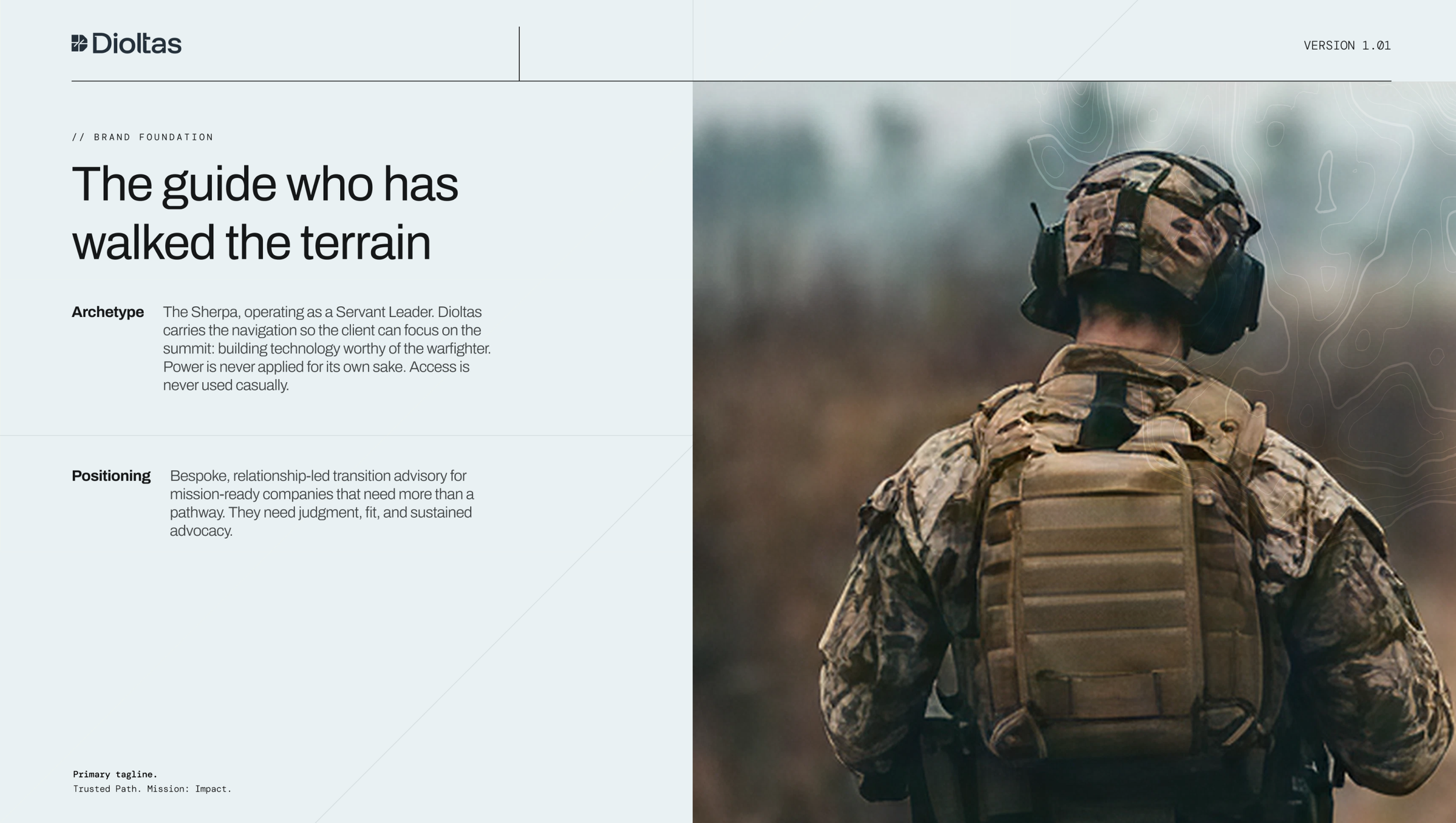
The rest of the field sells access. The introduction, the shortcut, the name to drop. Dioltas offers something those firms can't: the discernment to know which relationships actually matter, and enough earned trust that its word carries weight in the room.
So we stopped letting the category set the terms. Rather than competing on access, Dioltas would own what it truly delivers, judgment and trust, and build a category of one around it. The Trusted Pathfinder: the guide who has already walked the terrain, who carries the weight the climber shouldn't, and who stays long after the introduction is made.
“Every firm says it can get you in the room. Dioltas makes sure you belong there.”
You can't manufacture decades of earned trust in a rebrand, which is exactly why competitors can't follow onto this ground. That isn't a design outcome. It's a strategy outcome, and the design's only job is to make it feel true.
Only then, the design
Because the strategy said guide, not gatekeeper, the design had one test to pass, applied to every decision: does this signal trust and discernment, or does it perform authority? That test came straight from the positioning, so the hard calls were settled by strategy rather than by taste.
Strategy came before aesthetics. Every visual decision derived from the archetype and the positioning, never from trend. Because the Sherpa navigates real terrain, the identity borrows from the tools of navigation: field documents, annotated maps, survey precision, materials worn by use. That direction, Expeditionary Fieldcraft, was selected and confirmed by the Dioltas leadership team. The register is quiet authority. Nothing in the system shouts, because the brand it serves earns trust through restraint.
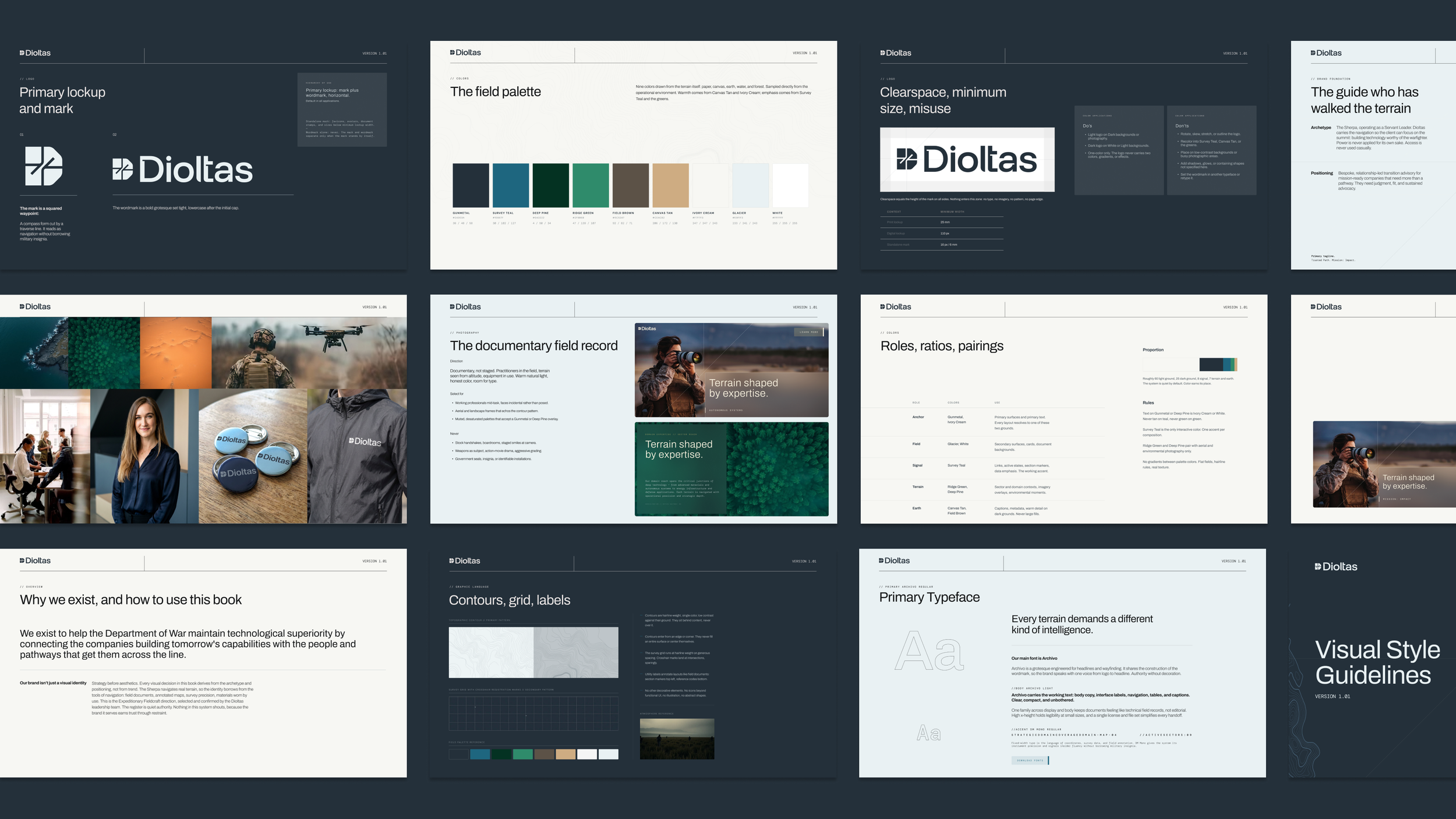
And one principle from the positioning governed everything else: the warfighter is the hero, never Dioltas. That rule kept the brand pointed outward at the mission instead of back at itself, so everything it produced reads as earned rather than announced. The design's only job was to make the strategy feel true, not to stand in for it. It's the proof, not the pitch.
What emerged
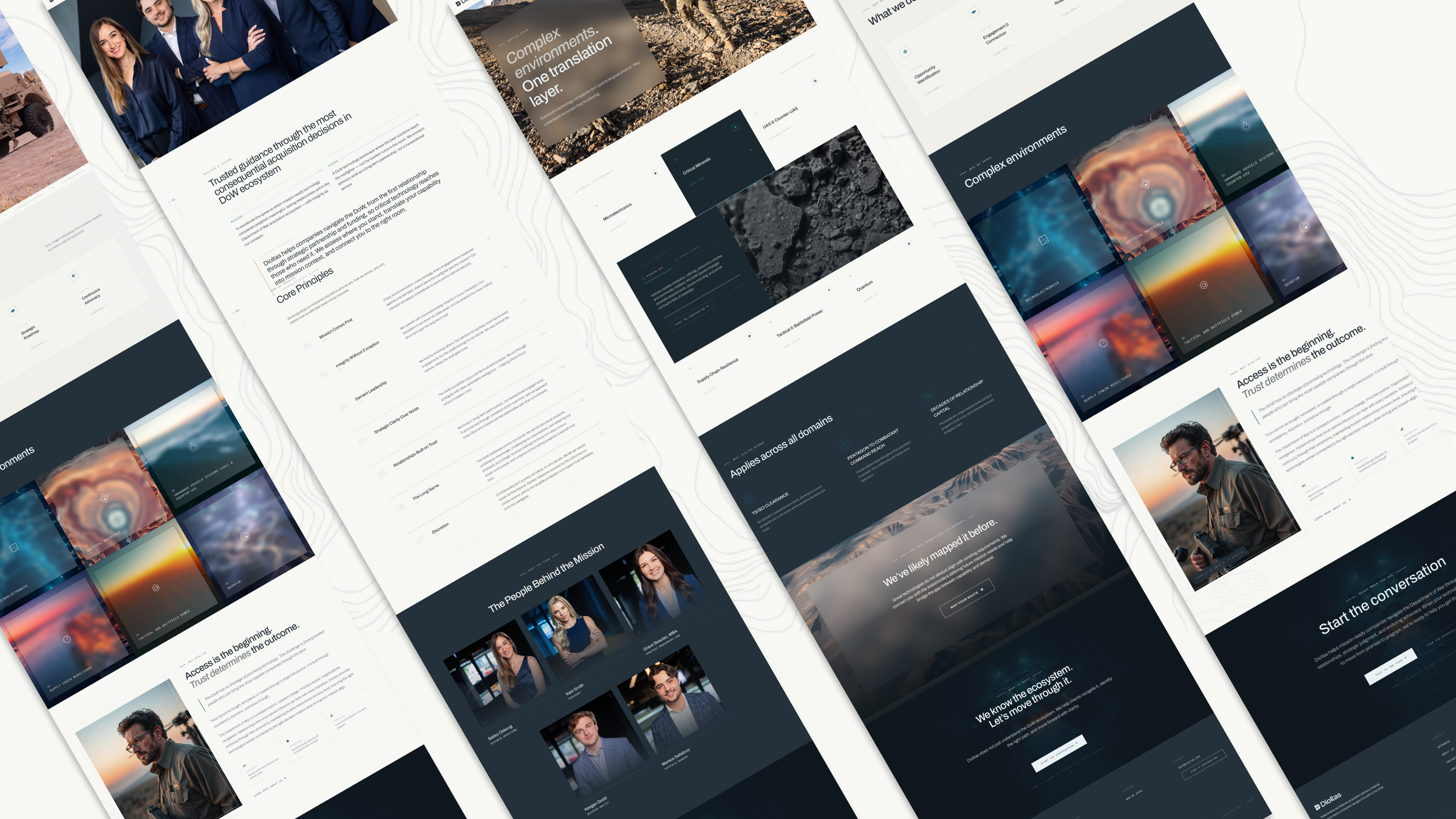
What Dioltas ended up with isn't a logo. It's a system where every element is deliberate, each one laddering up to the same strategic story. The positioning, the audience frameworks, and the manifesto all point to a single idea, so the brand holds together whether it shows up in a pitch, an outreach note, or a first meeting. Nothing has to be re-explained, because it all came from the same place.
The takeaway
Dioltas didn't need a louder voice. It needed a brand that finally said what its work had already earned, and a strategy strong enough that the design only had to carry it.
That's the work we do at Invisible Engine. We partner with companies building real things at the frontier of defense, deep tech, and dual-use, and we turn the substance that's hard to see into a brand that makes it obvious. We're here for the guts, not the glory. If your technology has already proven itself and your brand still isn't saying so, that's the gap worth closing.