Investors Fund Clarity. Build the Brand Before the Raise.
I want to tell you about a shift I've been watching in venture all year, because most founders still haven't caught up to it.
Investors have stopped treating brand as a nice to have. For years, the assumption was that brand came after the money. Raise first, then hire an agency to make it all look good. That order has flipped. Investors now expect the story to be sharp before they write the check, because a company that can't explain itself clearly to investors won't be able to explain itself to customers either. A weak brand at raise time doesn't read as "they'll fix it later." It reads as a company that hasn't done its thinking yet.
The smart founders see this and are building brand before the round, not after. They're betting that how clearly the market understands them affects how efficiently they can raise capital. From everything I've seen this year, they're right.
Your brand is telling investors things you never said out loud
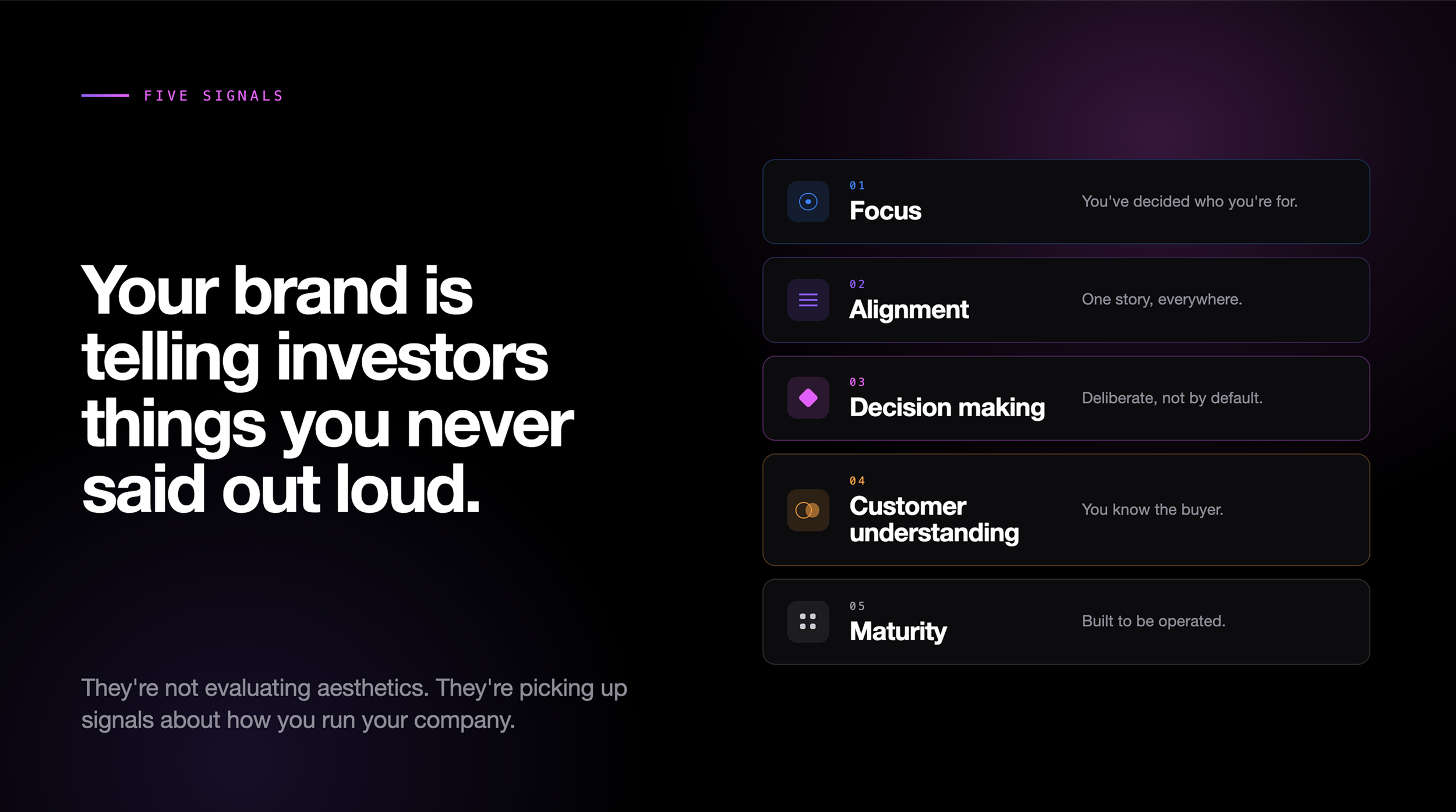
Here's what founders miss. When a VC looks at your brand, they're not evaluating aesthetics. They're picking up signals about how you run your company. Specifically, these five:
Focus: Clear positioning means you've decided who you're for and who you're not for. Trying to speak to everyone signals you haven't made the hard choice yet.
Alignment: When your deck, your website, and your answers in the meeting all tell the same story, it says your team is rowing in one direction. When they contradict each other, it says the founders haven't agreed on what the company is.
Decision making: A brand is hundreds of small decisions made deliberately. Sloppy, inconsistent branding suggests decisions at your company get made by default, not by design.
Customer understanding: Messaging that speaks to a real pain point proves you actually know your buyer. Generic messaging suggests you're guessing.
Maturity: A coherent brand says this company is built to be operated, not just pitched.
The research backs this up consistently. Studies have found investors are meaningfully more likely to fund startups with a cohesive brand identity, and a majority of investors admit branding shapes whether they believe a company can scale. None of this replaces traction. Nothing replaces traction. But between two companies with similar numbers, the one sending the stronger signals gets remembered, gets championed, and gets to a term sheet first.
So how does a stronger brand actually speed up a raise?
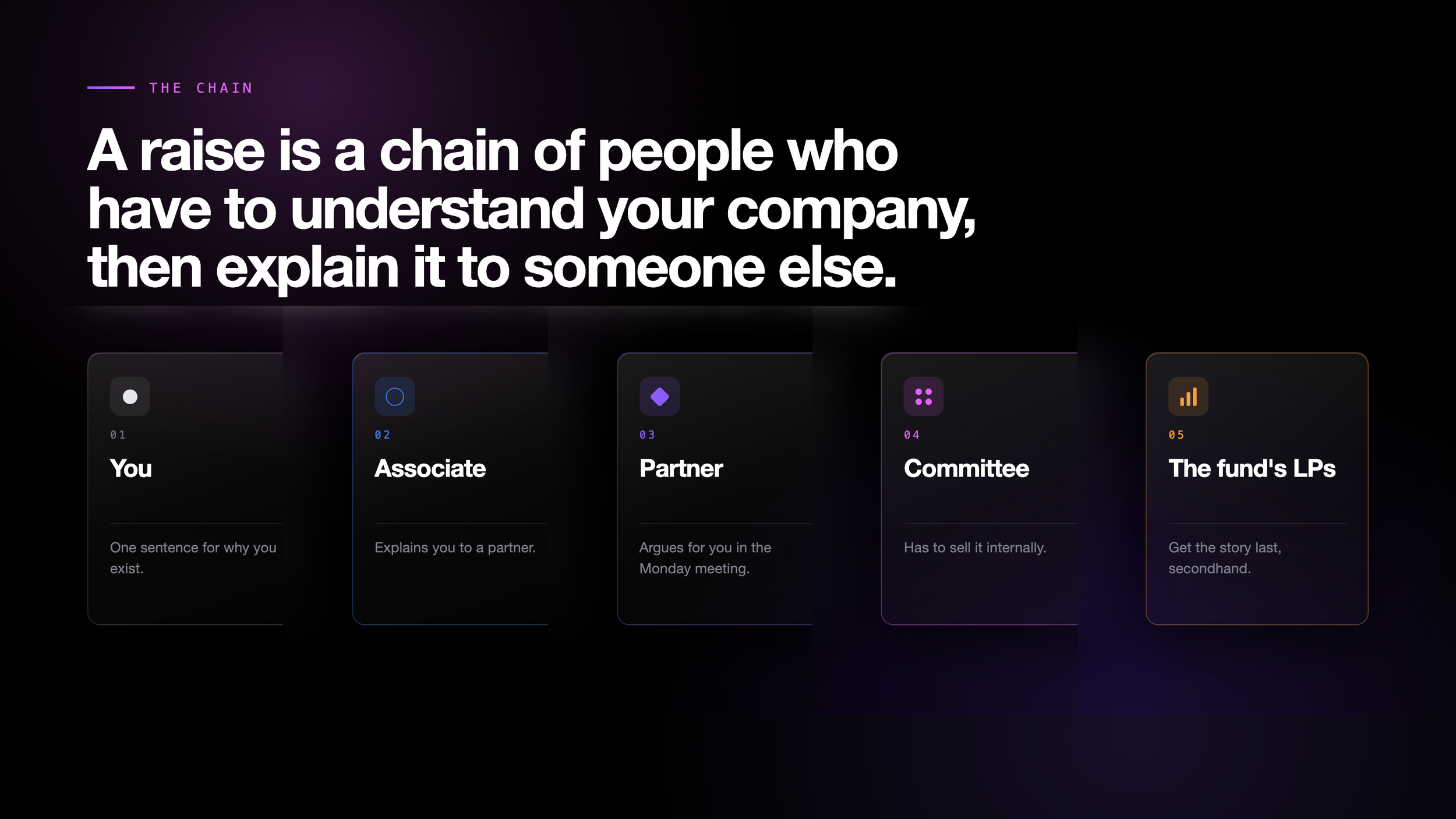
Those signals aren't just impressions. They change the mechanics of how a round moves. A raise is really a chain of people who have to understand your company and then explain it to someone else: an associate explains you to a partner, a partner explains you to the committee, the committee explains you to the fund's own investors. Every weak link in that chain costs you time. Brand is what strengthens the chain, and that matters because every extra month you spend raising is a month your competitors spend building.
It plays out in three real ways.
First, a clear brand makes you championable. Your round doesn't close in your pitch meeting. It closes when a partner walks back into their Monday meeting and argues for you while you're not in the room. Clear positioning hands that partner a one line story they can repeat word for word. If they can't repeat your story, they can't sell your story, and deals that can't be sold internally just stall.
Second, it speeds up diligence. When your deck, your website, your whitepaper, and your data room all sound like the same company, diligence moves. When they contradict each other, every inconsistency becomes a question, every question becomes another call, and another call becomes another two weeks.
Third, it lowers perceived risk. A clear brand tells an investor the market will understand this company, customers will be able to explain it to each other, and the next round's investors will get it too.
Clarity is built, not polished
Here's the part that matters most. None of this comes from making things prettier. It comes from doing the thinking underneath: deciding your positioning, choosing your customer, sharpening the one sentence that explains why you exist. That work is invisible in the final product, which is exactly why so many founders skip it. But it's the difference between a brand that holds up under diligence and one that dissolves under it.
Strategy is the engine behind every design, and fast raise too. If there's a round on your horizon, that thinking deserves a place on your roadmap right next to the metrics, because when the meetings start, both will be in the room.