Most founder explain features instead of marketing shifts
The fastest way to lose an investor isn't to have bad technology. It's to make them work too hard to understand why your technology matters.
Every week, founders walk into meetings prepared to explain what they've built. They talk about model accuracy, processing speed, proprietary architectures, and feature roadmaps. They answer every technical question with confidence. Then they leave wondering why investors seemed interested but never truly convinced.
The problem usually isn't the product. It's the story.
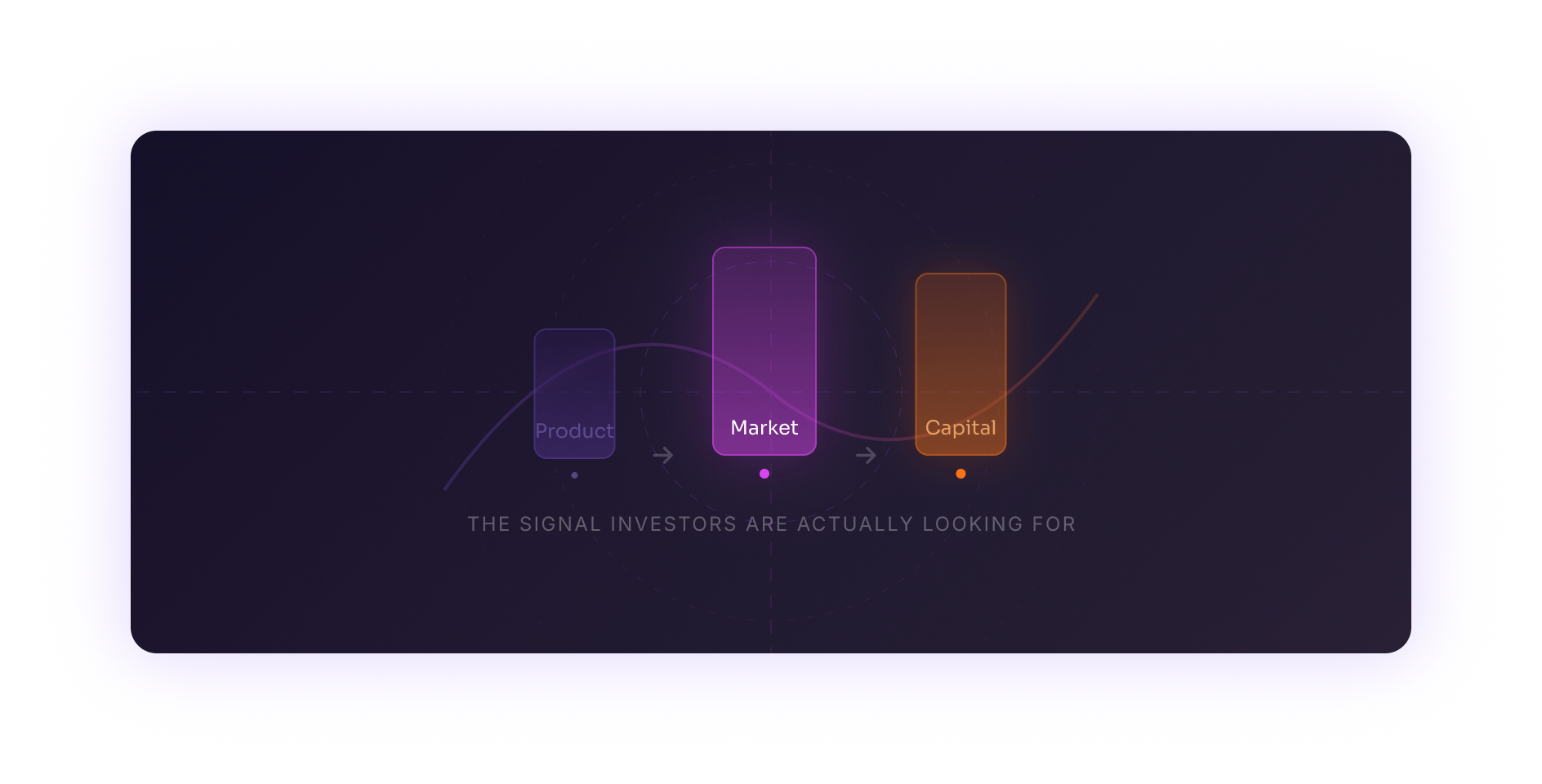
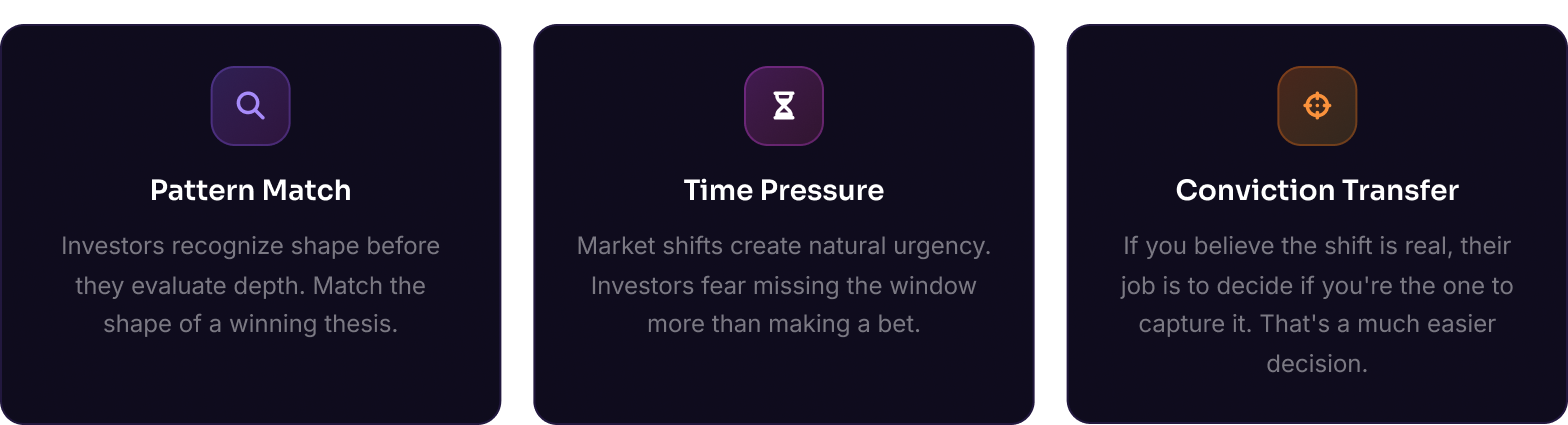
Investors rarely struggle to understand how a product works. They struggle to understand why the world suddenly needs it. Those are two very different conversations. Features explain capability. Market shifts explain inevitability. One tells people what you've built. The other tells them why your company exists at exactly the right moment.
The founders who become category leaders understand that distinction. They don't ask investors to connect the dots. They connect them first.
The argument investors are actually buying
Every meaningful technology company is built on top of a structural change that it didn't create.
Artificial intelligence reshaped computing. Modern geopolitical tensions reshaped defense procurement. Advances in biology reshaped drug development. Those shifts created entirely new markets before any individual company entered them.
The mistake many founders make is believing their product creates the opportunity. More often, the opportunity already exists. Their job is to explain why.
That's why positioning matters.
Features can always be compared. Someone else will eventually build something faster, cheaper, or more efficient. Market shifts are different. When a company becomes the clearest explanation for why the market is changing, it earns something far more valuable than differentiation. It becomes the reference point people use to understand the category itself.
The strongest companies don't simply participate in change. They define it.
Four companies that understood the assignment
NVIDIA
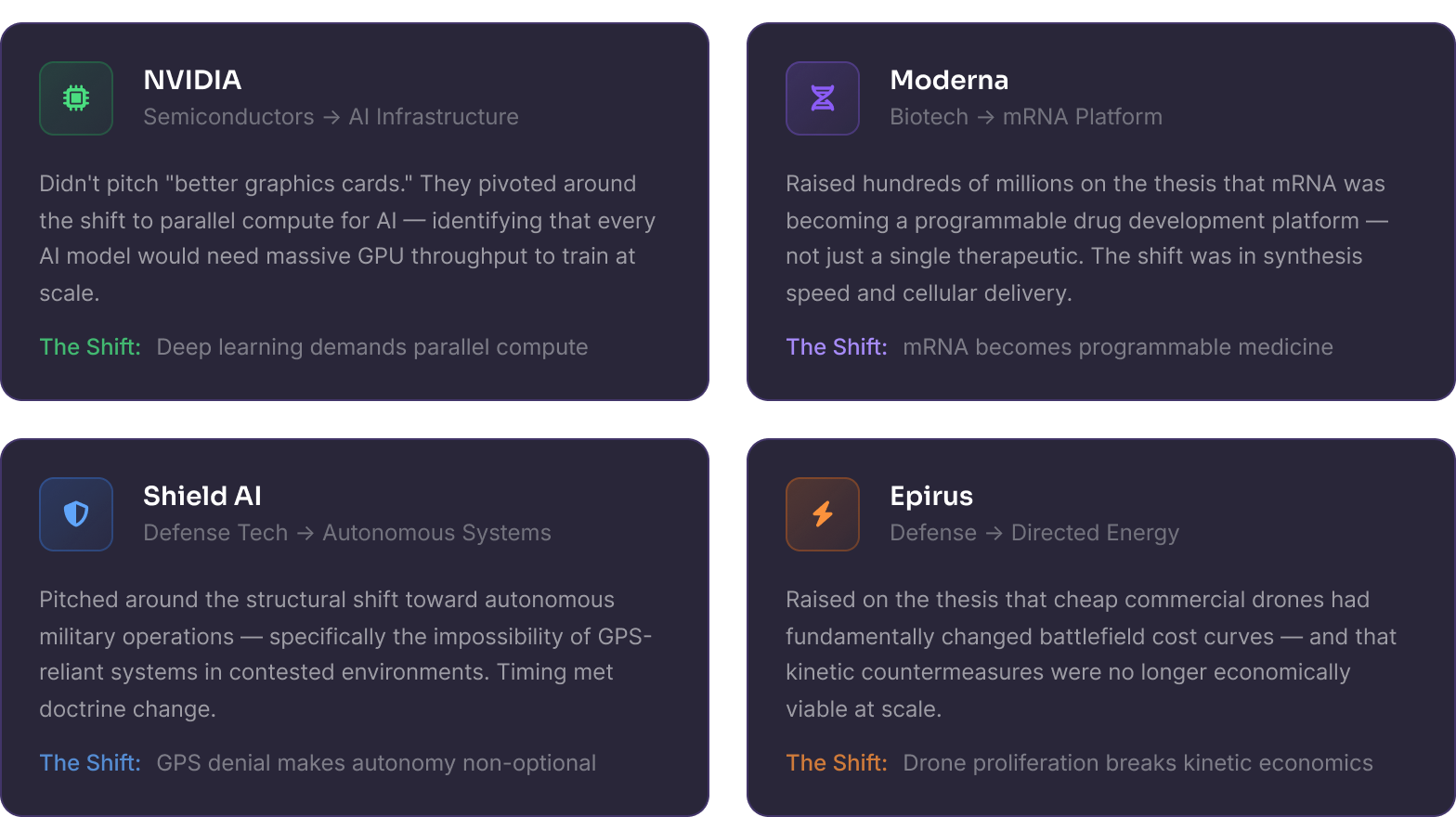
For decades, NVIDIA was known as a graphics company. Then artificial intelligence fundamentally changed what computers were expected to do.
Deep learning demanded massive parallel computation. CPUs weren't designed for that workload. GPUs were.
NVIDIA recognized that this wasn't simply another customer segment. Computing itself was changing. Instead of positioning around hardware specifications, memory bandwidth, or processing speed, the company positioned itself as the infrastructure powering the AI era.
A feature pitch might focus on Tensor Cores or benchmark improvements.
A market-shift pitch sounds completely different:
"AI has become a new computing paradigm, and the infrastructure built for yesterday's workloads can no longer support tomorrow's models."
One competes against other chips. The other explains why an entirely new class of infrastructure now exists.
Top companies that are reshaping the world
Moderna
Before Moderna had a commercially successful product, it had an idea powerful enough to attract billions of dollars in investment.
The idea wasn't a vaccine. It was programmable biology.
For decades, drug development meant discovering one molecule for one disease. Moderna argued that mRNA changed the process itself. Biology could now become a programmable platform capable of producing countless future therapies.
A feature-focused company talks about delivery systems and clinical data. A company defining a market shift talks about changing how medicine gets built.
When the COVID vaccine succeeded, it validated far more than one product. It validated the platform narrative Moderna had spent years building.
Shield AI
Technology doesn't change because engineers want it to. It changes because the environment demands it.
Modern battlefields increasingly operate in GPS-denied and communications-denied environments. Aircraft that depend on constant human control become vulnerable the moment those connections disappear.
Shield AI doesn't begin that conversation with autonomy software. It begins with the reality that warfare has changed. The product becomes obvious once the shift is understood.
Instead of saying, "Our software enables drones to operate without GPS," the stronger message is:
"Tomorrow's conflicts won't be won by platforms waiting for instructions. They'll be won by systems capable of making decisions when communication disappears."
That's a fundamentally different story.
Epirus
Perhaps no example demonstrates market shifts more clearly than modern counter-drone defense.
Consumer drones costing a few hundred dollars are forcing militaries to launch interceptors costing hundreds of thousands.
The technology problem isn't actually the most important one. The economic problem is.
Epirus recognized that reality early. Rather than positioning around microwave technology or engineering specifications, it positioned around a defense model that no longer makes financial sense.
The question stopped being, "How do we build better interceptors?" It became, "How do we defend against inexpensive threats without bankrupting ourselves?"
Once that question is accepted, the value of the product becomes almost self-evident.
Summary
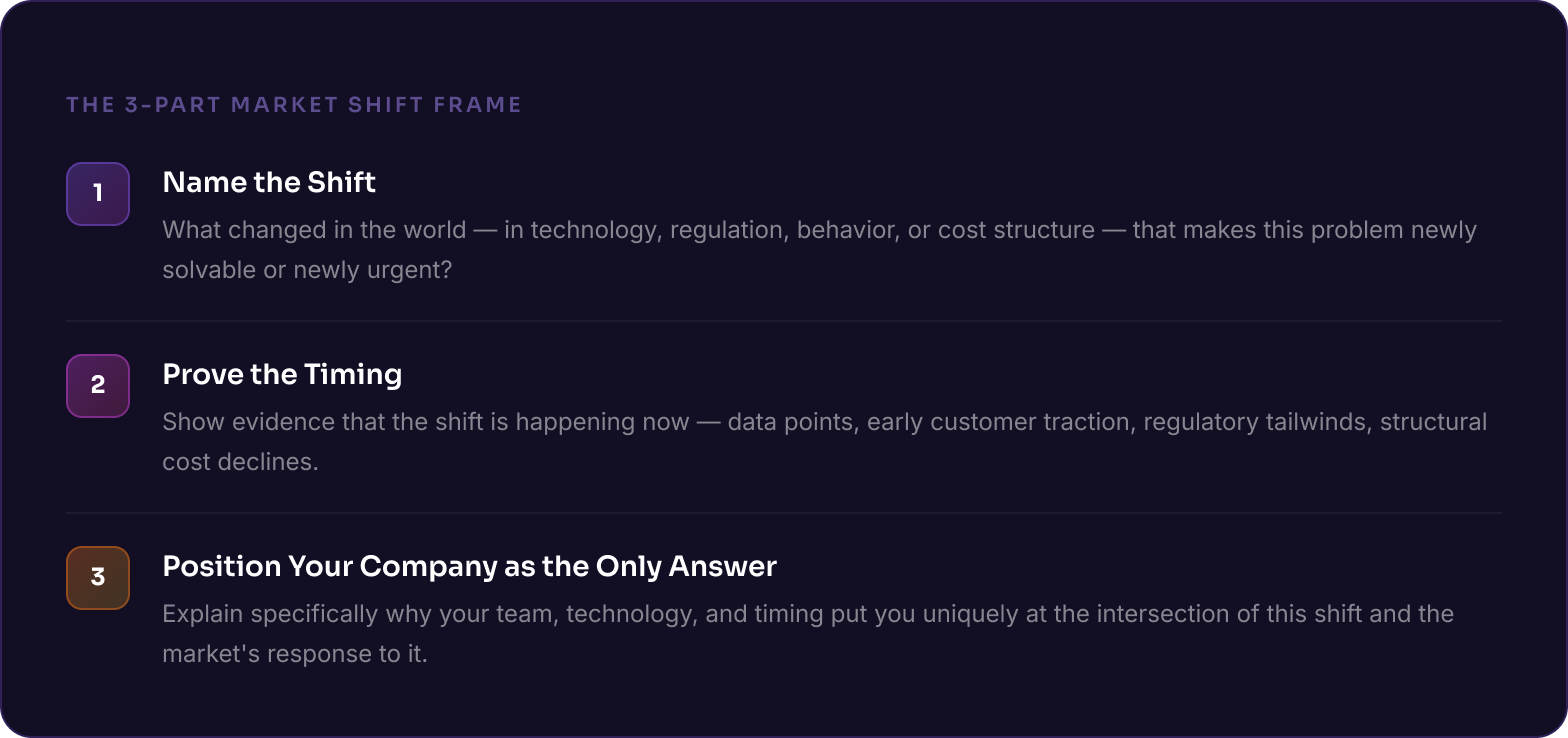
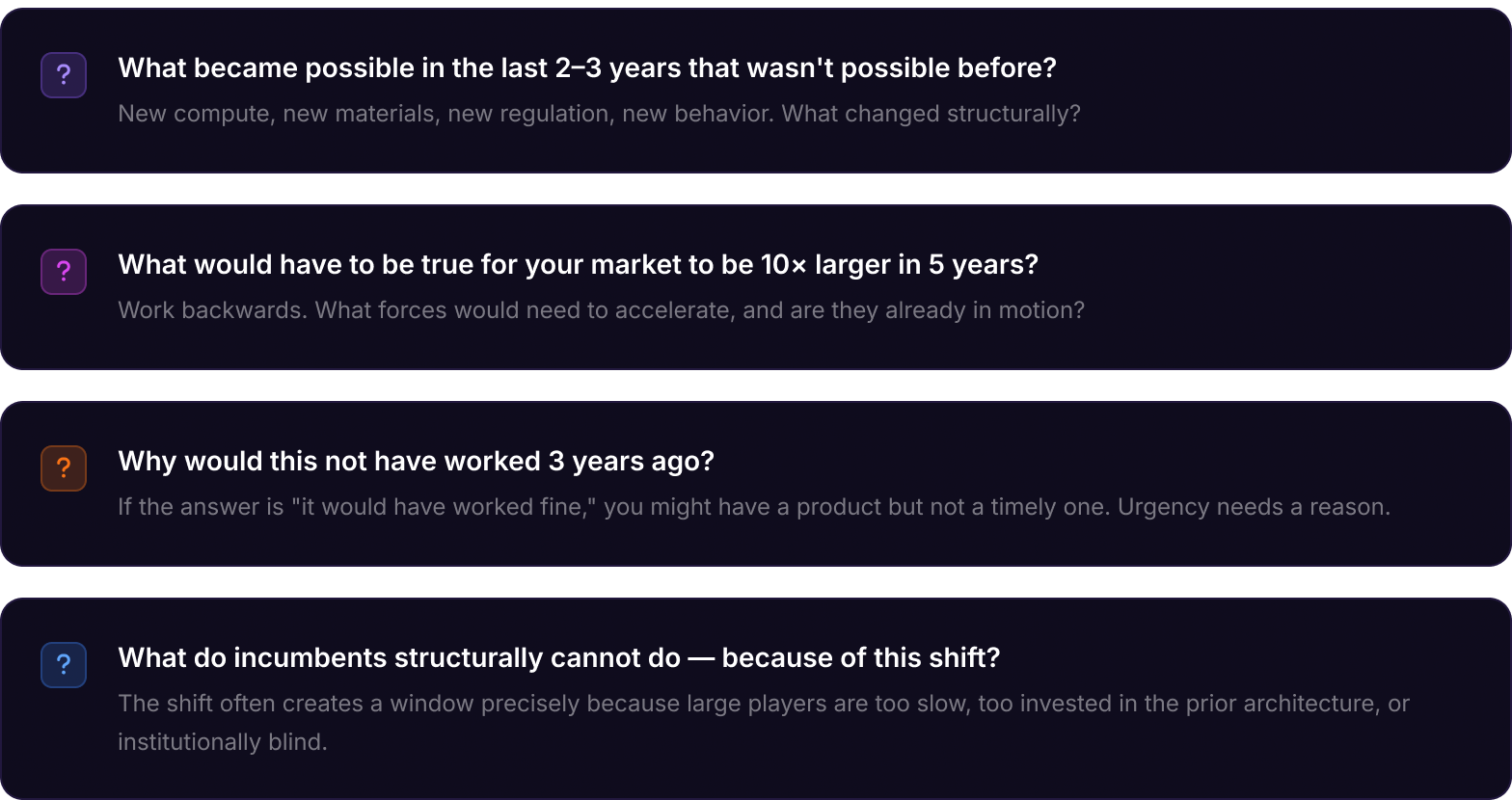
Every company above had exceptional technology, but that was not the differentiator. What separated them was their ability to explain why the world had changed before explaining what they had built. Most founders do the opposite. They spend months polishing product messaging, feature lists, and technical claims while barely defining the structural shift that makes the company matter. That is the mistake. Your first job is not to prove your product is impressive. Your first job is to prove the market has changed. Once an investor believes the shift, the product becomes much easier to believe in. If you cannot explain, in one sentence, what is true now that was not true five years ago, your positioning is not finished.
Before your next pitch
Before you update another product slide or rewrite another feature list, answer one question:
Don’t make investors connect the dots
If your technology is strong but your story still feels hard to explain, the issue may not be the product. It may be the market narrative around it.
Invisible Engine helps deep tech, defense, infrastructure, and advanced technology companies clarify the shift behind the business, sharpen the story, and build the materials that make people understand why now.
Before your next pitch, make the market shift impossible to miss.