Deep Tech Branding in the Age of AI
How Strategy, Design, and Rapid Prototyping Turn Breakthrough Technology Into Market Clarity
Deep tech companies don’t struggle with innovation. They struggle with explanation.
A team can spend years building a breakthrough in energy storage, advanced manufacturing, sensing technology, or AI infrastructure only to discover the hardest part isn’t building the technology. It’s helping the world understand what they built.
Investors need to grasp the scale of the opportunity. Customers need to understand the transformation. Employees need to believe in the mission.
And the window to communicate that clearly is shrinking. This is where deep tech branding becomes essential. Not as marketing decoration. But as a system that translates complexity into belief.
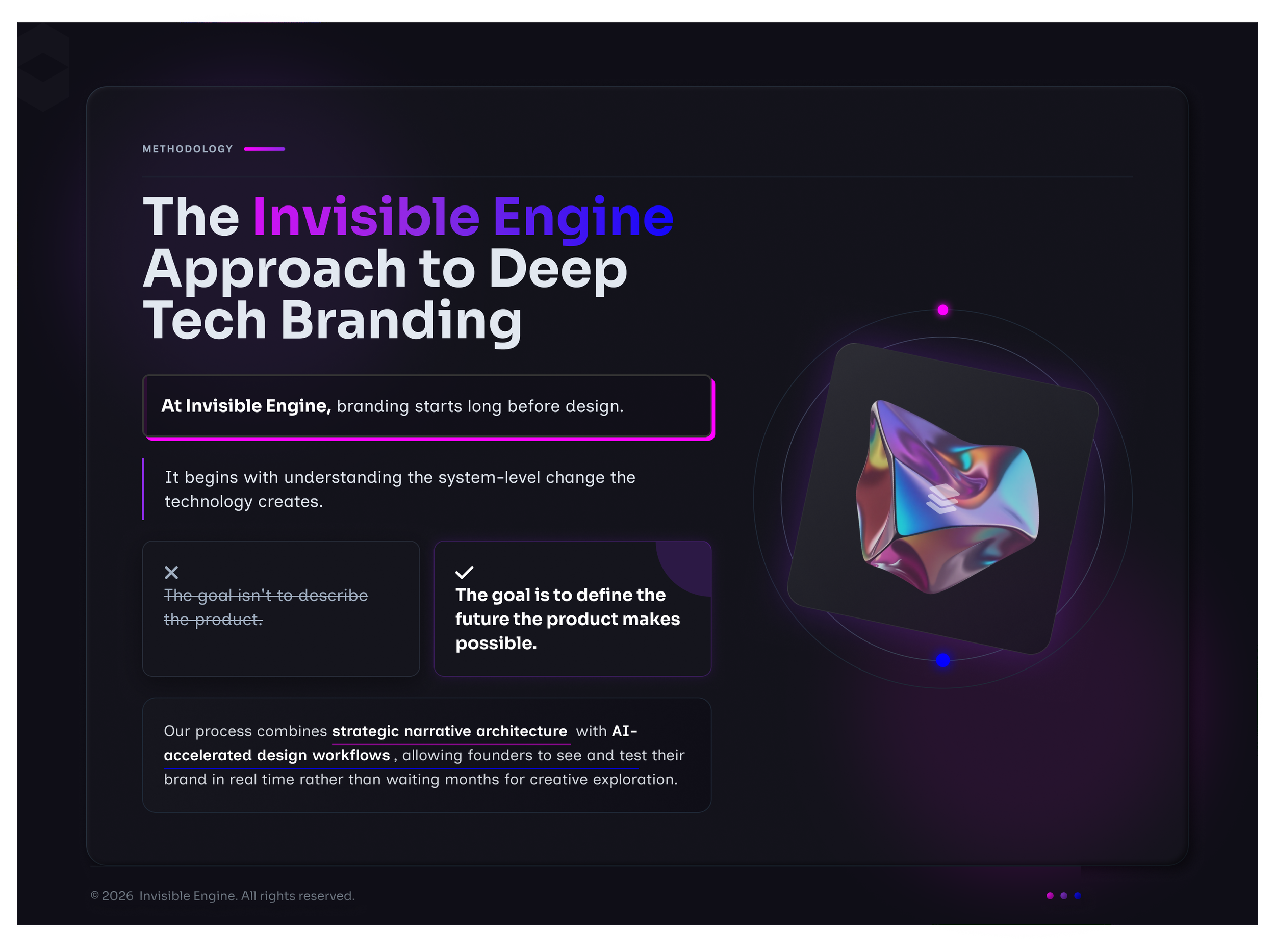
At Invisible Engine, branding starts long before design.
It begins with understanding the market inflection point the technology is entering. Deep tech companies rarely emerge in stable markets. They appear at moments when something fundamental is shifting. A new capability becomes economically viable, infrastructure constraints begin to break, regulation changes, supply chains fracture, or advances in AI unlock entirely new classes of tools. Often, physics that once lived only in the lab suddenly becomes manufacturable. These moments signal that the conditions for change are forming.
When those conditions appear, they create windows where entirely new categories can emerge. The companies that define these moments rarely win because they have the most features or the most complex technology. They win because they help the market understand the shift first. They articulate the new mental model before anyone else does. In deep tech, the narrative that frames the transition often moves just as fast as the technology itself.
Brand strategy, in this context, is not about explaining a product. It is about framing the market transformation the product represents. The goal isn’t to describe what the technology does. The goal is to explain the future state the technology makes possible and why the world is ready for it now.
Our process starts by identifying the forces creating that opening. We look closely at technological breakthroughs, economic pressures, geopolitical dynamics, and infrastructure limitations that signal the market is ready for a new approach. These signals reveal where an existing system is breaking down and where a new one can take hold.
Once those forces are clear, we translate them into a narrative architecture that positions the company not as another vendor in an existing category, but as a catalyst for the next one. Design then becomes the visible expression of that shift. And with AI-accelerated prototyping, founders no longer have to imagine what that brand might look or feel like months down the road. They can see it, test it, and refine it in real time.
Because in frontier technology markets, clarity isn’t cosmetic. It’s often the difference between leading the category and explaining it after someone else does.
Phase 1: Strategic Discovery
Identifying the System Change
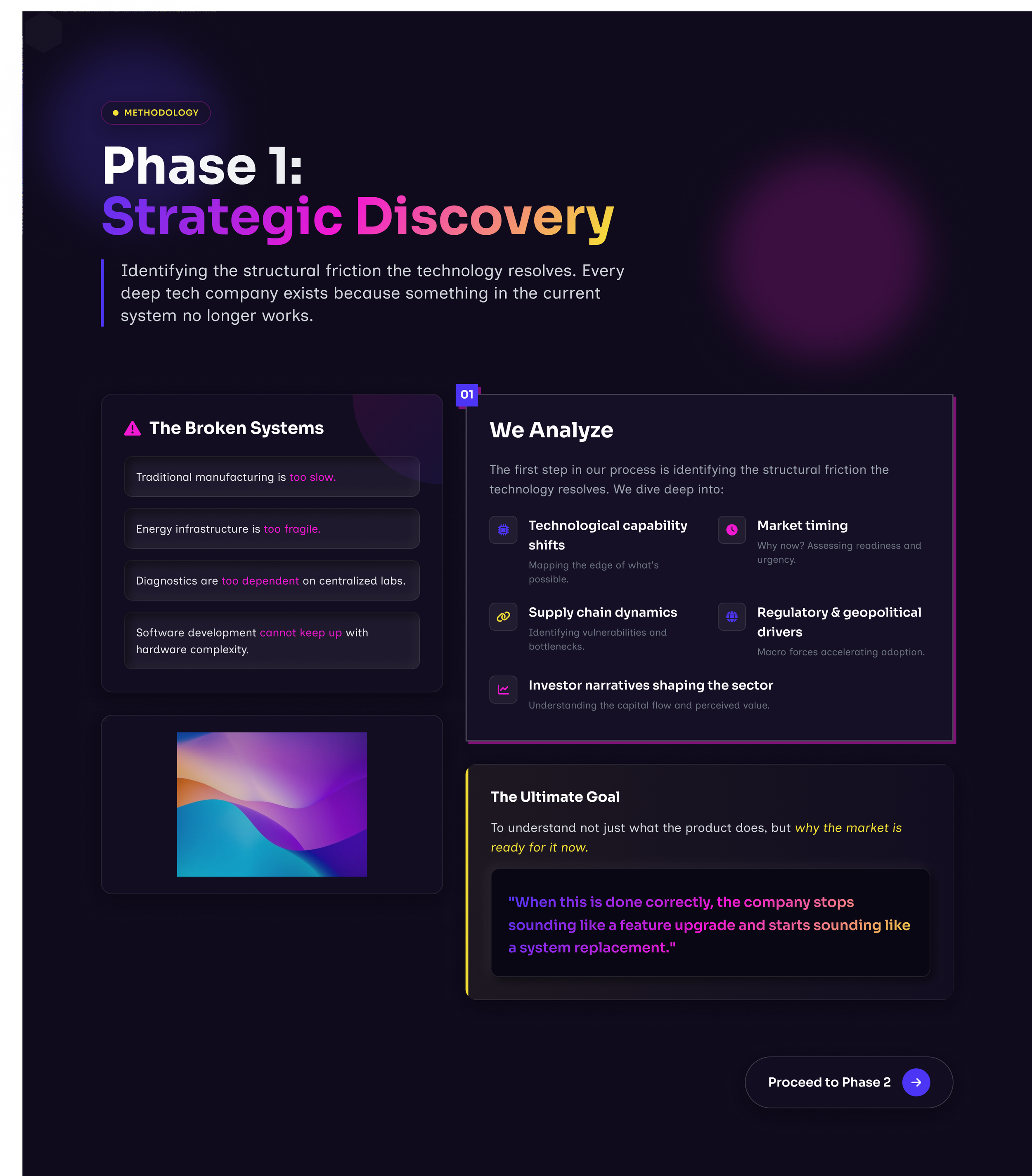
Every deep tech company exists because something in the current system no longer works.
Traditional manufacturing is too slow.
Energy infrastructure is too fragile.
Diagnostics are too dependent on centralized labs.
Software development cannot keep up with hardware complexity.
The first step in our process is identifying the structural friction the technology resolves.
We analyze:
• technological capability shifts
• market timing
• supply chain dynamics
• regulatory and geopolitical drivers
• investor narratives shaping the sector
The goal is to understand not just what the product does, but why the market is ready for it now.
When this is done correctly, the company stops sounding like a feature upgrade and starts sounding like a system replacement
Phase 2: Audience Intelligence
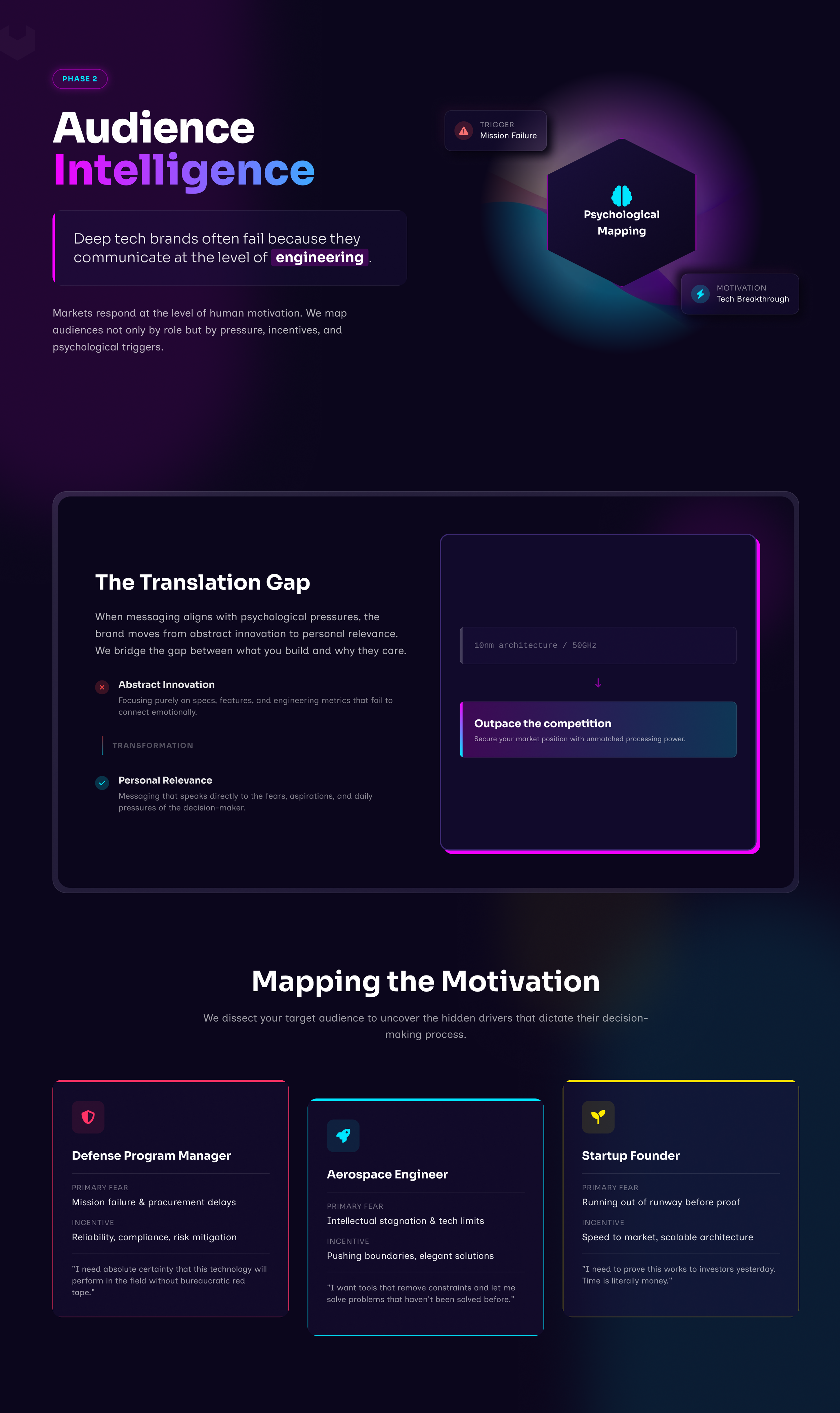
Deep tech brands often fail because they communicate at the level of engineering.
Markets respond at the level of human motivation.
At Invisible Engine, we call this stage empathy mapping. It’s the process of understanding not just who the audience is, but what pressures, incentives, and emotional drivers shape their decisions. Instead of viewing audiences purely through a functional lens, we analyze how they think, what they fear, what they are responsible for, and what success looks like in their world.
For example, a defense program manager isn’t simply evaluating a technology. They are managing the risk of mission failure, procurement bottlenecks, and national security pressure. An aerospace engineer may be driven by a different tension entirely. They worry about intellectual stagnation, technological limitations, or working within systems that prevent them from building what they know is possible. A startup founder faces yet another set of pressures: the race against runway, the need to prove the technology before funding runs out, and the constant expectation to deliver something that seems impossible.
Empathy mapping allows us to translate technology into meaning for each of these audiences. When messaging aligns with the real pressures people face, the brand moves from abstract innovation to personal relevance. Instead of describing features, the company begins speaking directly to the moments where decisions are made.
Phase 3: Narrative Architecture
Once the strategic foundation is clear, we construct the messaging system.
This typically includes:
• category definition
• messaging pillars
• founder narrative
• brand manifesto
• investor storytelling
• product language frameworks
This architecture becomes the operating system for communication across the company.
Product, marketing, sales, and fundraising all start telling the same story.
Instead of explaining features, the company begins explaining a new future.

Phase 4: AI-Accelerated Design Exploration
Historically, brand exploration could take months. Mood boards, concept sketches, visual territories, and narrative experimentation all required long cycles of iteration before founders could see where the brand might land.
Today, AI allows us to prototype entire brand worlds in days.
At Invisible Engine, we combine human creative direction with AI-assisted design workflows to explore strategic visual territories quickly while staying grounded in positioning. The goal is not to let AI decide the brand. The goal is to accelerate exploration, pressure-test ideas, and give founders something tangible to react to much earlier in the process.
This approach allows us to test multiple creative directions, visual metaphors, and narrative structures rapidly while ensuring everything remains aligned with the strategic foundation established earlier in the process.
Several tools play a key role in this workflow.
ChatGPT and Claude
These tools are primarily used during the narrative and strategy phases.
They help accelerate tasks such as:
• messaging architecture exploration
• founder narrative development
• category framing
• positioning refinement
• content ideation and blog strategy
• SEO optimization
• testing how messaging lands with different audiences
For example, we often stress-test positioning statements across multiple scenarios or audiences to see how clearly the story translates. This allows us to quickly identify language that resonates and eliminate explanations that feel overly technical or abstract.
Best practice is to treat these tools as strategic collaborators, not copy generators. Human judgment still determines the final narrative and tone.
Midjourney and Krea
These tools are extremely powerful during visual exploration and concept development.
They allow us to rapidly test visual territories and creative directions before moving into structured design.
For deep tech brands, this might include exploring visual languages inspired by:
• industrial infrastructure
• advanced manufacturing environments
• energy systems and plasma physics
• computational geometry
• architectural brutalism
• materials science textures
• high-precision engineering systems
Instead of building one concept direction at a time, we can explore dozens of aesthetic directions quickly. This speeds up the discovery phase and helps identify the visual territory that best reinforces the strategic narrative.
AI outputs are never used directly as final assets. Instead, they function as creative reference points that inform the human-led design process.
UX Pilot
UX Pilot is particularly helpful when transitioning from brand exploration into product and interface design. It allows us to rapidly generate wireframes, UI structures, and layout explorations based on functional requirements.
This is especially valuable for startups building complex software platforms where brand, product interface, and user experience must feel cohesive from day one.
Figma
Once a direction is validated, the work moves into structured design environments like Figma. This is where the brand becomes operational.
Within Figma we develop:
• scalable design systems
• website architecture and page frameworks
• UI components and interaction patterns
• investor pitch deck templates
• sales and marketing collateral systems
• brand guidelines and libraries
Figma becomes the single source of truth for how the brand functions across the organization.
Additional Tools in the Modern Creative Stack
Other tools increasingly play important roles depending on the project.
Adobe Firefly and Photoshop AI assist with production and image refinement.
After Effects is used for motion systems and brand animation.
Notion often becomes the hub for strategy documentation and content planning.
Webflow or Framer are frequently used to rapidly prototype and launch marketing sites once the design system is established.
Together, these tools create a workflow where strategy, design, and execution move much faster than traditional agency processes.
From Technology to Belief
When deep tech branding works, something powerful happens.Complex technology becomes understandable.
Investors grasp the opportunity faster. Customers understand the transformation sooner.
Teams inside the company rally around a shared vision.
The brand becomes a multiplier for the technology itself. Because breakthrough innovation alone doesn’t change the world. Understanding does.
Invisible Engine works with founders building the next generation of infrastructure, energy systems, advanced manufacturing platforms, and frontier technologies.
We combine market insight, narrative architecture, and AI-accelerated design workflows to transform breakthrough innovation into category-defining brands.