Archetypes: The bedrock of every great brand
Most agencies want to start with your color palette. We want to start with your soul.
Every brand that actually moves people starts with something ancient: story. And at the heart of every great story? An archetype. Not the logo. Not the tagline. Not even the "vibe deck" your last designer sent over. The archetype is the psychological bedrock that makes all of that other stuff actually mean something.
Here's the truth: if your brand doesn't feel right, it's usually because the archetype is either undefined or completely confused. And when that happens, no amount of pretty fonts will save you.
In this article, you’ll learn:
Why every timeless brand starts with story, not aesthetics
How archetypes create emotional alignment across design, voice, and culture
Why defining your brand’s soul brings clarity to every creative decision
How hybrid archetypes make brands more dimensional and human
Ways to use archetypes as internal culture tools, not just external design cues
Why archetypes still matter (Spoiler alert: they always have)
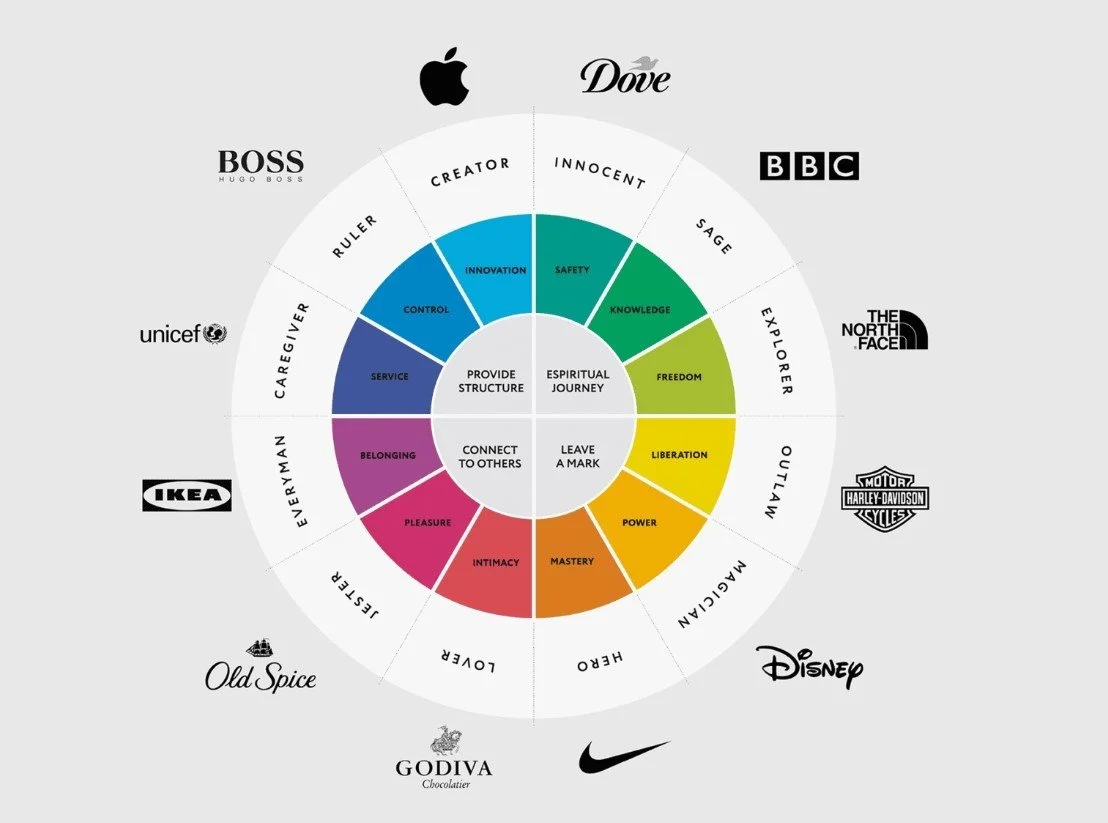
Carl Jung wasn't thinking about branding when he mapped out archetypes the Hero, the Creator, the Rebel, the Sage, but he might as well have been. These universal characters live in our collective unconscious. They're shortcuts to emotion, recognition, and trust. They give your company a soul.
Think about Nike's Hero energy: "Just Do It." Apple's Creator ethos: "Think Different." Harley-Davidson's Rebel swagger: "Live to Ride." These aren't taglines dreamed up in a conference room brainstorm. They're expressions of an archetype that runs through everything, the campaigns, the color palette, the customer service scripts.
We worked with a fintech startup once that came to us drowning in beige. Safe messaging. Stock photos. The kind of branding that screams "we're trying not to offend anyone." But when we dug into their origin story, we found founders who'd left Wall Street specifically because they were sick of the bullshit. They wanted to democratize access. They had fire.
Once we named it, once we gave them permission to be the Maverick, everything clicked. Suddenly the design choices weren't subjective anymore. They were strategic. Clean but confident. Sophisticated but fearless. A voice that led instead of followed, that trusted the customer's intelligence instead of talking down to them.
That's what archetypes do. They turn "what feels right?" into "what is right."
The foundation for look, feel, and voice
Archetypes aren't window dressing. They're your compass. They dictate everything:
Look: The Creator loves white space, clean lines, and room to imagine. The Rebel prefers texture, grit, and visual tension.
Feel: The Caregiver evokes warmth, safety, and trust. The Explorer thrives on movement, curiosity, and possibility.
Voice: The Sage speaks with authority and precision. The Jester brings levity, wit, and a wink.
Once your archetype is locked in, design stops being a guessing game. Every texture, tone, and transition reinforces who you are at a primal level. Your brand becomes a system, not a style guide.
New Trends in Archetype-Driven Branding
Most companies lock into one archetype and call it a day. But some brands naturally express more than one—not because they're confused, but because they live and communicate across different dimensions.
Having multiple archetypes isn't about being unfocused. It's about recognizing that a brand can sound one way, act another, and feel another—and still be cohesive.
Here's how we think about it:
1. The Rise of Hybrid Archetypes
Brands don't fit into neat boxes anymore, and honestly? They never really did.
A brand can be both Magician and Servant Leader: innovative yet humble, bold yet grounded. A SaaS company can be a Sage in their thought leadership and a Hero in their sales process. This isn't confusion, it's multidimensionality.
We see this with the best tech companies all the time. They know how to teach (Sage), inspire action (Hero), and surprise with elegance (Magician), all without feeling schizophrenic.
How a brand can have multiple archetypes
Most companies lock into one archetype and call it a day. But some brands naturally express more than one, not because they're confused, but because they live and communicate across different dimensions. Having multiple archetypes isn't about being unfocused. It's about recognizing that a brand can sound one way, act another, and feel another and still be cohesive.
The Voice Archetype: How You Sound
This is your brand's personality in conversation. It's how you write, speak, and show up online. Are you a Sage who teaches? A Jester who entertains? A Magician who inspires awe? Your voice archetype shapes tone, vocabulary, rhythm. It's what your audience hears when you speak.
The Ethos Archetype: Who You Are at the Core
This is your internal compass, what you value, how you make decisions, the culture that drives your mission. A Hero ethos thrives on challenge and perseverance. A Caregiver ethos builds trust through service. A Creator ethos fuels relentless innovation. Your ethos archetype is your "why." It's the one your team feels every day.
The Perception Archetype: How the World Sees and Feels You
This is the emotional impression you leave behind. It's not what you say, it's how people experience you. A Sage may sound wise but feel distant if not balanced with warmth. A Rebel may be bold but feel abrasive if not grounded with purpose. Your perception archetype is the mirror: the way your audience internalizes your story and the emotions it triggers.
When these three align: voice, ethos and perception, your brand feels intentional and multidimensional. When they're out of sync, it's like watching a dubbed foreign film where the lips don't match the words. Understanding which archetypes show up where helps you bring them back into harmony.
2. Archetypes as Culture Builders
Here's something most agencies won't tell you: archetypes aren't just external branding tools. They're internal alignment engines.
When your whole company knows you're a Hero, your sales team stops apologizing for your price. Your designers stop second-guessing bold choices. Your CEO stops hedging in investor decks. The archetype becomes a shared vocabulary, a culture code as much as a brand code.
We've seen companies go from scattered to synchronized in a matter of weeks once they define their archetype. Suddenly, design, sales, and leadership are all rowing in the same direction. Not because someone sent a memo, but because they finally understand who they are.
3. From Personas to Pattern Recognition
AI is changing the game, and archetypes are evolving with it.
Instead of building static personas, "Sarah, 34, works in marketing, drinks oat milk lattes", smart brands are now mapping archetypal motivations. The Creator wants to make something new. The Explorer wants to discover something unknown. The Magician wants to transform reality.
This shift lets brands build adaptive messaging systems that evolve in real time. Your content doesn't just speak to demographics. It speaks to drives. And that's where the magic happens.
4. Texture and Tone as Archetype Signals
Visual storytelling is getting more archetype-specific. Designers are blending motion, typography, and sound to express brand archetypes viscerally:
The Magician uses gradient light and particle motion.
The Hero uses bold typography and kinetic transitions.
The Sage uses precision grids and timeless serif type.
Fuel for Thought
At Invisible Engine, archetypes are our ignition point.
They're the framework that gives brands a spine, not just skin. We don't start with what you make. We start with why it matters, who it serves, and how it moves people. From there, we craft the visual and verbal systems that turn purpose into perception.
We're here for the guts, not the glory. And the guts? They start with knowing who the hell you are. Because your brand isn't just what people see. It's what they sense, what they remember, what they feel in their gut when they think of you.
And that starts with archetypes.
Ready to find your brand's soul? Let's dig in. Get in touch